
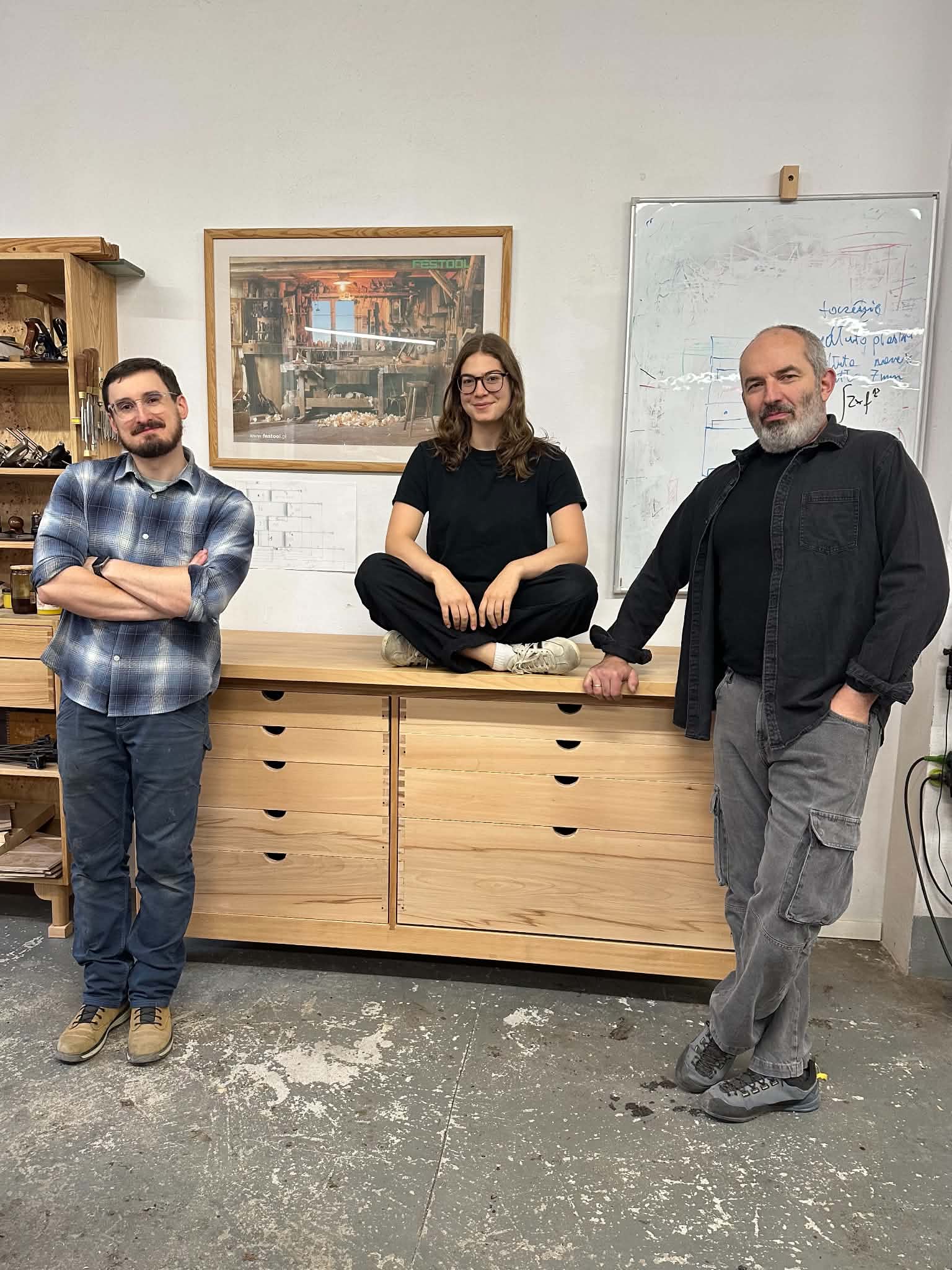
By Tom Bensari, master woodworker and vocational instructor
From 1 September to 31 October 2026, Hana, a furniture design student at Nottingham Trent University in the UK, completed a woodworking placement at Bensari Workshop in Wrocław, Poland. Her placement was organised in cooperation with the university. For two months, she was part of our team, taking part in all our woodworking courses and the daily work of the workshop, helping us make furniture and workshop equipment.
During her stay, Hana developed her skills with saws, planes, chisels and scrapers, as well as marking out and cutting mortise-and-tenon and dovetail joints. She also learnt hammer veneering, steam bending and turning pens and fountain pens.
Hana worked with both hand tools and woodworking machinery. An important part of her placement was understanding how to choose tools and methods to suit the material, the stage of work and the intended result. This is how I understand conscious woodworking: knowing the material and the construction, and making informed decisions about how to carry out each task.

Working with Nottingham Trent University
Welcoming a student from Nottingham Trent University into our workshop was a real privilege. I am grateful to the university for trusting us and giving me the opportunity to contribute to the education of someone as engaged and curious as Hana. It is encouraging to see that the experience I have gained as a craftsman and designer can be useful to someone developing her skills in an international academic environment.
I value NTU’s approach, which brings together design, an understanding of materials, prototyping and making. Her placement at Bensari Workshop allowed Hana to develop these skills through everyday workshop practice. She could draw on what she had learnt at university, test her ideas and explore the traditional techniques I use to create contemporary furniture. This connection between design education and practical craftsmanship is what makes working with universities so valuable to me.
My particular thanks go to Fiona Davidson, who coordinated Hana’s placement at Nottingham Trent University, for her help with organising the placement and preparing for Hana’s stay. I appreciate the time and attention she devoted to making this visit possible and helping it become a valuable part of Hana’s studies. I hope we can continue working together and welcome more NTU students to our workshop in Wrocław. I would be delighted to share my workshop and experience with them.
Learning woodworking in a working furniture workshop
Alongside teaching courses and hosting placements, I design and make collectible furniture, working with international designers and architects. The experience I gain through these projects directly informs what I teach and how I teach it. Students can observe practical challenges, discuss construction methods and take part in solving problems that arise during a build.
Learning begins before the first joint is cut. I take every student on placement to the timber yard, and Hana also had the opportunity to see how I select material for particular projects. We looked at boards, their grain, defects and potential uses. For a future furniture designer, this is valuable experience: decisions that affect a piece’s construction and appearance begin with timber selection.

Two months is certainly too short to learn the entire furniture-making process and understand how individual decisions affect the finished piece. That experience comes through years of working on successive projects. A placement offers the chance to practise different techniques, apply them to a piece of furniture and see which skills need further work. For a future designer, it is also an opportunity to better understand a furniture maker’s work and how to collaborate with the people who will make their designs.
The tool cabinet
Hana’s main project was a tool cabinet made from steamed beech, built together with Marek, who is completing his vocational training with us. The cabinet has nine drawers of different heights, made with dovetail joints, and a top with drawbored mortise-and-tenon joints. We use the same technique during our Mortise-and-Tenon Joinery Course, where participants make traditional cutting boards.
Beech is valued for projects like this because of its hardness, resistance to wear and fine texture, which allows for a smooth surface. We also use steamed beech to build woodworking benches. In 2025, apprentices from Les Compagnons du Devoir built three Split-Top Roubo workbenches in our workshop as part of the Erasmus+ programme.

I often tell course participants that making equipment for their own workshop is a good way to begin woodworking. These projects make you think through the whole process, from timber selection and construction to fittings, drawer runners and fitting the drawers. They also teach humility: an inaccuracy at one stage can make itself felt during assembly.
With this cabinet, I wanted Hana and Marek to consider every aspect of the piece, including its ergonomics and how we would use it. The cabinet is staying with us, and reaching for tools every day will show how well their decisions work in practice.
Veneer hammers for future course participants
During her placement, Hana also made a batch of veneer hammers for traditional hammer veneering with hot bone glue. She made the wooden heads and handles and fitted brass blades, carefully rounding and polishing their edges.
It is the brass edge that presses the veneer onto the substrate, squeezing out excess glue and air. Its smooth, rounded surface allows the tool to move across delicate veneer without catching or tearing it. We also choose brass because it avoids the dark staining that can occur when iron comes into contact with tannins in the wood.

Making these tools involved a different set of practical decisions from building the cabinet. Hana combined machine work with hand-tool techniques, paying attention to the fit of the components and the finish of the working edges. The hammers will now be used on our Hammer Veneering and Steam Bending Course, helping other participants learn the technique she practised during her stay.

Thank you, Hana
Hana brought plenty of positive energy and good humour to our workshop. She quickly became part of the team and was a wonderful companion to our course participants as they worked and learnt together.
It was also lovely to meet some of her family and discover our shared love of good food. Hana enthusiastically explored Polish cuisine, and shared meals and conversations around the table became an important part of those two months.

Hana, thank you for your work, commitment and all the positive energy you brought to Bensari Workshop. I am glad we had the chance to get to know you and spend this time together. It was a real pleasure to be part of your woodworking journey. See you again!


