
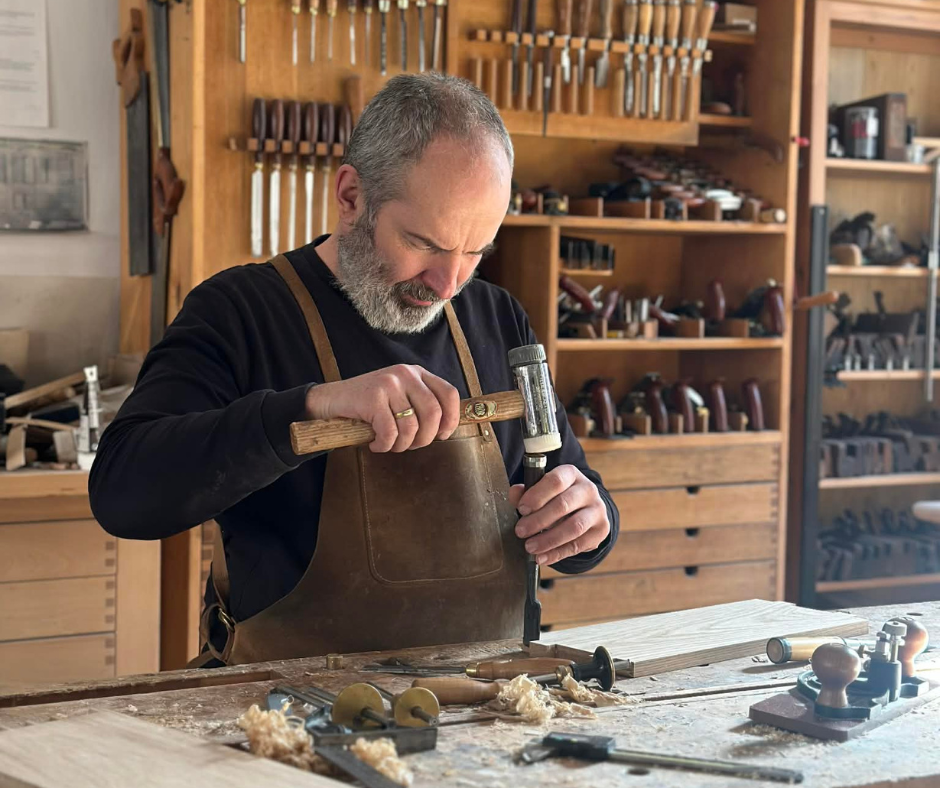
In recent years I have noticed a growing interest in traditional craftsmanship. In a world dominated by industrial production and digital tools, working with wood using hand tools has become something rare. For many people it is also deeply satisfying.
Because of this, more and more people are searching for places where they can learn traditional woodworking techniques directly in a real workshop environment.
One of the questions I receive most often is simple:
Where can I find a traditional woodworking course in Europe where I can learn how furniture is actually made?
This is exactly the kind of learning environment we try to create at Bensari Workshop in Wrocław, Poland.
A working woodworking atelier
Bensari Workshop is not only a place where courses take place. It is first and foremost a working furniture studio.
Every day the workshop is filled with hand planes, chisels and measuring tools used to build furniture and interior elements. Participants attending courses learn in the same space where real projects are designed and constructed.
This is important, because woodworking cannot be fully understood through demonstrations alone. It becomes meaningful when you see how techniques are used in everyday practice.
During the courses participants observe the full process of furniture making: selecting wood, preparing surfaces, cutting joinery and assembling structures.
Traditional woodworking techniques in practice
The techniques taught in the workshop come directly from everyday furniture-making practice.
Classic joinery methods such as mortise and tenon joints and dovetails have been used by woodworkers for centuries. Their strength comes from geometry and an understanding of how wood behaves, not from mechanical fasteners.
During the courses I try to explain not only how these joints are made, but why they work.
Understanding the logic behind traditional woodworking techniques changes the way people approach woodworking. Instead of simply copying steps, they begin to understand the structure of furniture.
Learning to work with hand tools
One of the most important skills in woodworking is preparing a perfectly flat wooden surface.
Before any joinery can be cut, wood must be dimensioned and refined. That is why one of the introductory workshops focuses on working with hand planes and cabinet scrapers.
Participants learn:
• how to set up and adjust a woodworking plane
• how to use a cabinet scraper correctly
• how to read wood grain
• how to plan the process of flattening wooden surfaces
These are fundamental skills used by furniture makers all over the world.
Courses led by furniture maker Tom Bensari
I am a furniture maker and designer working with wood using traditional techniques.
My furniture is represented internationally by the New York gallery STUDIOTWENTYSEVEN and appears in private collections and architectural projects.
I have also published an article in Fine Woodworking – one of the most respected sources of knowledge about traditional woodworking techniques.
Publications and international recognition
Furniture created in my workshop has been featured in international publications dedicated to architecture, design and craftsmanship, including Architectural Digest, Robb Report and Elle Decoration.
For me this recognition is important because it shows that traditional craftsmanship can still play an important role in contemporary design culture.
International craft exchange
A few months ago I had the pleasure of hosting young craftsmen from the French organisation Les Compagnons du Devoir.
This historic guild, with roots reaching back to the Middle Ages, trains generations of craftsmen who travel across Europe learning their trade through practical work in different workshops.
Their stay in Wrocław took place within the Erasmus+ programme and was a valuable exchange of knowledge and experience. Working together showed once again that woodworking is a universal language shared by craftsmen across cultures.
A unique course: hammer veneering and steam bending
One of the most distinctive workshops offered at Bensari Workshop combines hammer veneering and steam bending.
These two traditional woodworking techniques have been used by cabinetmakers for centuries, yet today they are rarely taught together.
During the course participants go through the entire process: preparing veneer, applying hot hide glue with a veneer hammer and bending wood using steam and forms.
Participants learn:
• how to build a simple steam box for bending wood
• how to prepare bending forms
• how compression straps prevent wood from cracking
• why timing and temperature are crucial in the bending process
In practice, success often depends on small details such as moisture content of the wood, temperature of the steam and the speed of placing the piece into the form.
Participants do not only observe the process – they experience it directly.
What participants learn during the course
Courses at Bensari Workshop focus on practical skills and a deeper understanding of wood behaviour in furniture construction.
Depending on the course, participants learn:
• how to prepare wood surfaces with hand planes and scrapers
• how to understand grain direction and wood movement
• how to cut traditional joinery such as mortise and tenon or dovetails
• how to plan the sequence of work in furniture construction
• how techniques like hammer veneering and steam bending are used in practice
Beyond technical skills, the workshops also focus on the mindset of working with wood: patience, precision and respect for the material.
Why People travel to learn woodworking in Europe
In recent years I have met more and more participants who travel to Wrocław from different parts of Europe to attend courses.
Many people searching online for a traditional woodworking course in Europe are not simply looking for a hobby class. They want to learn how craftsmen think about materials, structure and form.
Courses take place in small groups so that each participant can work at the bench and experience the tools directly.
For many visitors the most valuable aspect is seeing how traditional woodworking techniques are used in a workshop where furniture is actually being made.
Planning your visit to Wrocław for a woodworking course
For many participants attending a course is also an opportunity to visit a new place. Wrocław is one of the most interesting historic cities in Central Europe and easy to reach from many European destinations.
The city has an international airport and good train connections with cities such as Prague, Berlin and Kraków.
Bensari Workshop is located within the Dawna Pralnia Loft Design complex, a historic post-industrial site that today hosts studios of designers, craftsmen and creative businesses.
Visitors will also find several excellent restaurants on the grounds of the Dawna Pralnia complex, some of which are listed in the Michelin Guide – an unexpected but very pleasant detail for those who combine learning craft with discovering local cuisine.
Many participants decide to extend their stay in the city. Wrocław is known for its historic market square, numerous islands and bridges, and a lively cultural scene that makes it a rewarding place to spend a few days.
Learn woodworking at the workbench
Woodworking is a craft that is best understood through practice. Books and videos can explain many techniques, but real understanding begins at the workbench.
This is the idea behind the courses at Bensari Workshop.
Participants learn traditional woodworking techniques in a working furniture studio, surrounded by the tools, materials and processes that shape everyday craft practice.
If you are interested in learning woodworking in a real atelier environment, you are welcome to visit the workshop in Wrocław.
📍 Bensari Workshop
Wrocław, Poland, Krakowska 180, Dawna Pralnia Loft Design – Building P
Frequently Asked Questions
Are woodworking courses taught in English?
Yes. Courses at Bensari Workshop can be conducted in English. Many participants come from different European countries, so explanations and demonstrations can be provided in English when needed.
Do I need previous woodworking experience?
No. Many participants join courses without previous woodworking experience. Beginners learn fundamental skills while more experienced woodworkers can refine their understanding of traditional techniques.
Do I need to bring my own tools?
No. All essential tools and materials are provided in the workshop. Participants work with professional woodworking tools used in everyday furniture-making practice.
How many people attend a course?
Courses usually take place in small groups. This allows each participant to work directly at the bench and receive individual guidance during the workshop.
Where is Bensari Workshop located?
Bensari Workshop is located in Wrocław, Poland, in the historic Dawna Pralnia Loft Design complex at Krakowska 180.


2 Responses
Hi, I am inquiring about the workshop for my son who is already studying wood in school and interested in improving his skills. Could you please tell me what sort of workshops are there? I mean the duration and also do we need to arrange the accomodations by ourselves?
Hello, thank you for your message and for your interest in the workshops.
At Bensari Workshop we organize short, practical woodworking courses that usually last one or two days. The workshops take place in a working furniture studio and focus on traditional woodworking techniques and hand tool work.
You can find the current course dates and descriptions here:
https://www.bensariworkshop.com/en/carpentry-courses/
Accommodation is not included, so it needs to be arranged individually. Fortunately Wrocław has a very large range of hotels, apartments and hostels, so finding a place to stay is usually not a problem.
Participants under 17 years old can attend the course together with a parent or legal guardian.
If you have any additional questions, feel free to ask. We will be happy to help.