

Furniture with tambour doors have long been a signature element of our woodworking studio and the Bensari Ébénistes brand. It is the precisely crafted tambours, with continuous grain, rhythmic slat layout and smooth movement, that have brought us recognition among clients and designers who value traditional craftsmanship in a contemporary form.
Every project that includes a tambour door is our tribute to historic woodworking techniques and to those who knew how to combine skill with function. It is also a story about respect for the material and for the workshop, where every detail matters. There is also a Wrocław chapter in this story, but more on that in a moment.
A few years ago, Fine Woodworking magazine published my article “Tambour Doors Now and Then,” devoted to the history and craft of tambour construction. It introduced woodworking enthusiasts around the world to how traditional techniques continue to inspire contemporary furniture design.
The beginnings of tambour doors
The history of tambour doors reaches back to eighteenth-century France. At the court of Louis XV, the royal ébéniste Jean-François Oeben designed a cylinder desk with a movable cover composed of thin wooden slats glued to a flexible cloth and sliding along hidden tracks. After his death, the work was continued by his student Jean Henri Riesener, who in 1769 delivered the monumental bureau du roi to the king, a piece still regarded as a symbol of woodworking excellence.
At first the tambour served a practical purpose, allowing the worktop to be closed quickly and protecting royal documents. Over time its rhythmic structure also gained an aesthetic role, appearing in cupboards, secretaries and chests of drawers. In the nineteenth century the technique gained popularity in the United States, where it evolved into the well-known roll-top desk.
Tambour doors in modernism
In the 1920s tambour doors drew the attention of European modernists. Their rhythm, lightness and functionality aligned perfectly with the new way of thinking about form.
Le corbusier and the idea of furniture as architecture
In 1925 Le Corbusier and Pierre Jeanneret presented the Pavilion L’Esprit Nouveau in Paris, a manifesto of modern interior design. Instead of decorative art déco furniture they introduced “équipement d’intérieur,” a system of modular built-ins and cabinets forming an integral part of architecture.
The central elements were the “casiers standardisés,” combining the qualities of furniture and wall. Some of them featured movable panels and screens that allowed the compartments to be closed with a single gesture, a solution close to today’s tambour doors. Le Corbusier treated furniture as an architectural component that organizes space rather than decorates it. This concept shaped later thinking about built-ins and modular systems and still inspires designers and enthusiasts of modernist interiors.
Władysław wincze, wood, experimentation and the workshop
In the Polish context, the work of professor Władysław Wincze (1905–1992) holds particular significance. He was a designer and educator connected to the State Higher School of Fine Arts in Wrocław (today the Academy of Fine Arts). He was one of the first designers in Poland to bring tambour furniture into professional practice. His pieces — cupboards, bar cabinets, secretaries — combined modernist simplicity with precise craftsmanship and a deep understanding of wood. At the turn of 2019/2020 the Museum of Architecture in Wrocław held the exhibition “Władysław Wincze. Interiors,” which showcased the designer’s versatility and his intimate knowledge of wood as a material. Among the exhibited works were also his tambour pieces.
Wnętrza Władysława Wincze | Elle.pl
Professor Wincze saw wood not as a utilitarian material but as a living substance with sculptural potential. He was fascinated by its morphological qualities: the rhythm of the grain, irregular textures, tonal contrasts and natural variability. In his teaching he encouraged students to experiment with the material, observe its behavior and follow its structure throughout the design process. He believed that understanding wood requires practice and direct contact, the ability to work with hand tools and attention to how wood reacts to each tool and traditional technique.
The workshop and the apprentice–master relationship
As a co-founder of the Interior Architecture department in Wrocław, Wincze initiated the creation of woodworking workshops at the school, convinced that design and craft are inseparable. He believed artistic education should be based on practical experience and that only through working with tools and materials can a student understand the essence of form.
This model of passing on knowledge, based on the relationship between apprentice and master, is also central to the teaching philosophy at Bensari Workshop. Courses in my studio are not only about technique. They are a space where participants learn to observe the material, understand its logic and respect its nature. As a result, projects emerge that combine the discipline of craft with the personal sensitivity of the student.
Technical aspects of making a tambour door
Creating a tambour door is a process that requires not only precision but above all a deep understanding of how the material behaves. Every stage, from selecting the wood or plywood to gluing and assembly, influences the smoothness, durability and reliability of the mechanism.
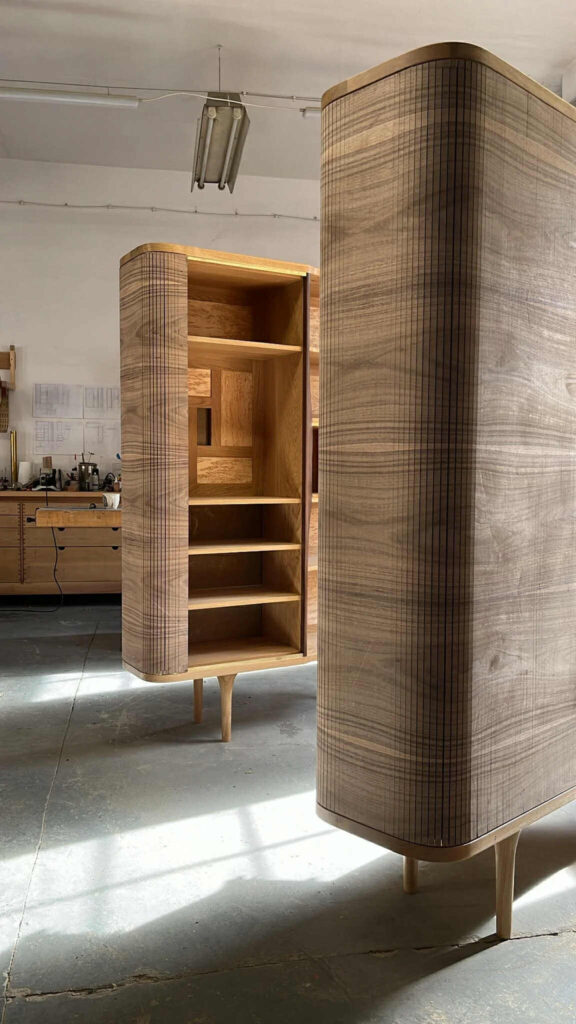
A key factor in assembly and use is geometry. It determines whether the tambour will move lightly and without catching, and whether it will maintain an even rhythm and clean line. Even small deviations in angles, track radius or slat width can affect the entire mechanism. Every element, from the flexible backing to the tracks, must be perfectly aligned for the motion to remain smooth.
From an aesthetic perspective, maintaining continuous grain is equally important, which requires precise cutting of veneer or solid wood.
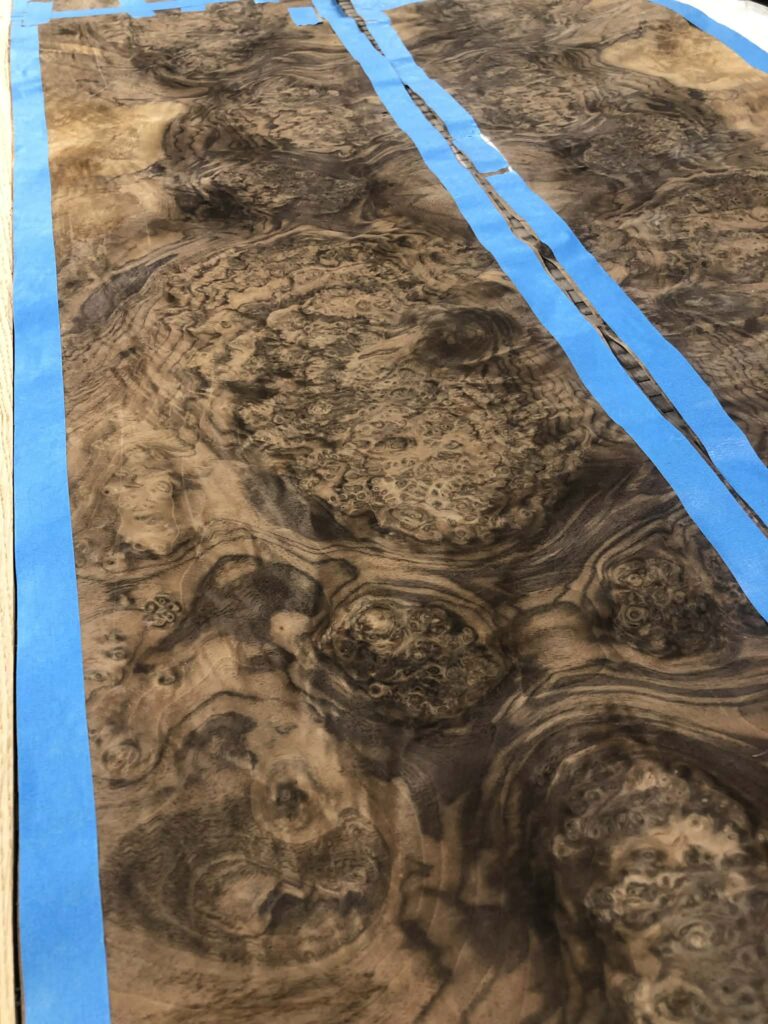
The backing, usually natural linen or cotton canvas, should be dense and resistant to stretching. I avoid synthetic fabrics because they may lose elasticity and crumble over time. Another crucial component is the glue. I use Titebond III because it has a long open time and allows precise positioning of veneer and cloth. Historically, tambours were glued with hide or bone glue, which offered elasticity and worked well with fabric and delicate veneers.
For veneered tambours or those made from very thin slats, plywood can serve as a stable multilayer core that resists humidity changes and internal stress. Good quality hardwood plywood ensures an even surface for veneering and reduces the risk of warping. A balancing veneer on the back is essential to counteract tension and maintain geometric stability.
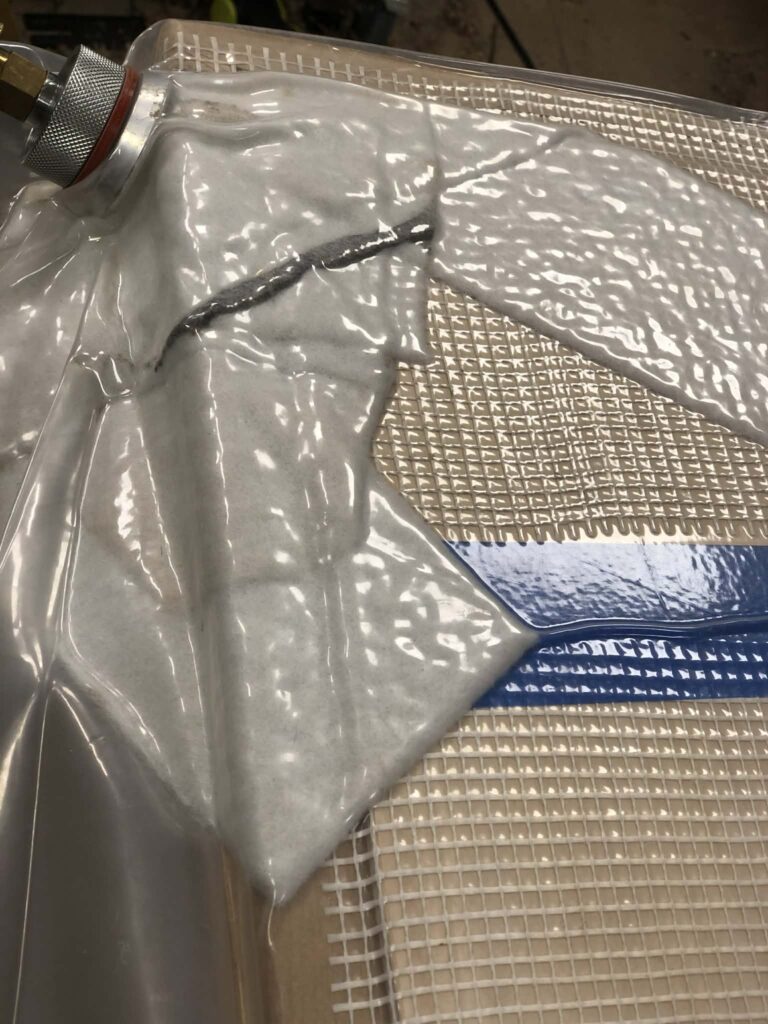
Veneering the tambour and attaching it to the canvas are done in a vacuum bag. Precisely cut cauls prevent veneer and cloth from shifting and ensure an even bond. We also use breather mesh to improve air removal from the bag.
In Bensari Workshop we pay particular attention to stability and durability. This is not only a matter of aesthetics but also resistance to changes in temperature and humidity. Most tambour furniture made in our studio travels long distances by sea or air to clients and galleries around the world. Every detail must therefore be engineered so the tambour survives the journey and retains perfect geometry once unpacked in a completely different climate.
Precise geometry, the right glue, a stable backing and controlled tension are what ensure that a tambour from Bensari Workshop keeps its form, lightness and function, no matter where it ends up.
Tambour doors today, craft in motion
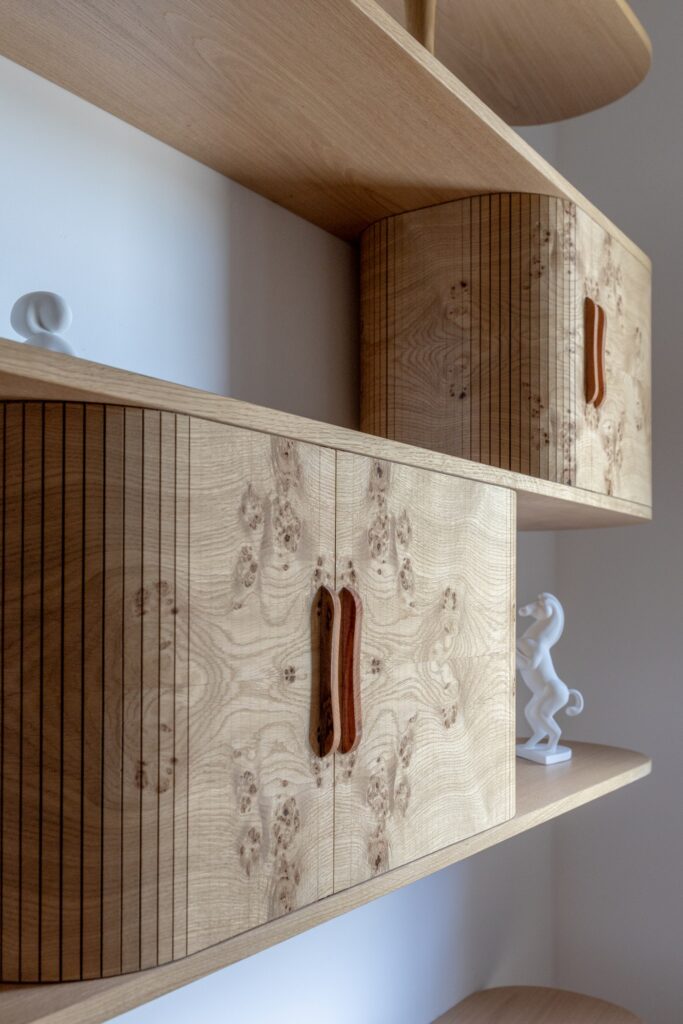
Contemporary tambour doors are not merely a reinterpretation of historic techniques. For me they represent high-level craftsmanship, a construction meant to function in motion and therefore requiring perfect execution. In our workshop the tambour becomes a tool of expression. It brings movement to a piece and introduces the natural grain of wood into interior spaces. Each one is also a testament to our patience, precision and focus, qualities that define true craftsmanship.
Summary
From the royal bureau du roi to American roll-top desks, from the tambour furniture of Władysław Wincze to the contemporary work of Bensari Workshop, the history of the tambour door is a story of dialogue between people and wood. It is a story of craft that connects tradition with modernity and of a workshop that works with deep respect for the lineage of woodworking.

