
The narrative of “saving craftsmanship” and its consequences
I was inspired to write this article by voices in the public sphere describing traditional woodworking techniques as outdated, slow, and merely hobbyist practices. I am often asked whether this kind of woodworking still makes sense or whether I use traditional woodworking techniques simply because they are “cool.” Sometimes people try to find advantages in the quiet operation of hand tools (try striking a chisel with a mallet a few times in an apartment building, and your neighbors will quickly correct that assumption). However, what moves me most in today’s discussion about craftsmanship is the growing narrative about the need to “save” traditional woodworking techniques from being forgotten.
This assumption is fundamentally flawed. Traditional woodworking is not outdated; it is simply very often misunderstood. It is not about preserving old methods for the sake of preservation itself, but about consciously using them wherever they provide a quality advantage or save time.
Perhaps the greatest harm to traditional woodworking today is done by those who reduce it to forgotten techniques, folklore, or nostalgia for working with old tools. Bogdan Kosak describes this brilliantly in the book Self-Portrait of a Craftsman, published by the Academy of Fine Arts and the Silesian Museum in Katowice. In his essay, contemporary craftsmanship is portrayed as a victim of ongoing economic and social changes, forcibly pushed into the framework of sentimentality and the romanticization of handmade objects.
This distracts our attention from the real advantages of craftsmanship and from the paradigm shifts I will discuss throughout this series. Turning traditional woodworking into a museum exhibit will not help it survive, let alone evolve. I do not assume this attitude comes from bad intentions, but rather from a lack of understanding of craftsmanship, its historical context, the absence of intergenerational transmission, and partly from the collapse of vocational education, which has caused skilled trades to be treated as an inferior career choice. Our task as woodworkers is to demonstrate how traditional woodworking techniques can be applied in the modern world and how they can coexist with contemporary solutions that complement them. But to do that, we need conscious woodworking.
The premise of this series and the starting point
With this article, I am beginning a series dedicated to identifying and justifying the place of hand tools in contemporary woodworking. I do not want to convince you that every woodworker should use them, but I want to show you the areas where they are justified in terms of both time and quality.
Let us begin with the fact that the conditions in which modern woodworkers operate have changed. Technology has provided us with solutions that dramatically shorten the furniture-making process. In the past, trees had to be felled by hand, often removed from difficult terrain, sawn manually, and dried for years. Today, most of these processes are highly automated and take a fraction of the time. For woodworkers, technology has become a major convenience and has fundamentally changed the rules of the game.
A paradigm shift – knowledge, skills, and technology
From my perspective, one of the greatest changes is the shift in paradigm itself. Traditional craftsmanship was always based on knowledge and manual skills. Today, that very foundation has changed – contemporary woodworking is no longer built primarily on knowledge and manual ability, but increasingly on the ability to operate technology. Manual skills were once a prerequisite for becoming a woodworker at all. The traditional apprentice and master training system was long and demanding. For centuries, the woodworker was both designer and maker. It was the craftsman who decided on construction, understood the material, and guided the entire process from concept to finished object. Knowledge of wood, tools, and joinery was inseparably connected to practical work.
It was only the Industrial Revolution that introduced a clear division of roles. Design and engineering began to function separately, while execution gradually detached itself from the decision-making process. With the rise of mass production, unique handmade objects began to lose significance, and craftsmen were pushed away from the design stage.
Today, a large part of woodworking is based on technology, and skills are often reduced to machine operation instead of arising from a deep understanding of material and construction.
Knowledge has been heavily reduced, if not eliminated entirely, as evidenced by the state of vocational education, the position of guilds, and the significance of trade examinations in the market. I should also add that another paradigm changed along the way – warranty periods and liability were reduced to a single year, giving poorly constructed furniture or low-quality budget technologies a chance to survive, while giving the woodworker peace of mind. Under such conditions, knowledge is treated almost like a hobby, and today virtually anyone can become a woodworker.
I am an example of this myself – I became a woodworker without attending trade school. I gained my knowledge and skills independently over many years by participating in international woodworking courses, reading professional literature, and dedicating every free moment to developing my woodworking abilities. It took me more than twenty years, and my first workshop was a small garage next to my house. Only after all those years of preparation did I take the examinations organized by the Lower Silesian Chamber of Crafts.
Technology does not replace skill
This paradigm shift reduces furniture-making exclusively to a matter of access to better technology. Throughout the industrial era, technology has somehow begun to give us a sense of security. Unfortunately, that sense is often false.
Once, a well-known Polish writer visited my workshop and, while looking at my Chameleon collection audio cabinet, tried to be polite by saying that to make furniture like this, you must need very good equipment. I asked him what he used to write his books. He answered, “A computer.” I replied, “Then perhaps if you had a better computer, you would write better books.” He immediately understood the analogy.
Over the years, I have also observed my interns. In difficult situations, when they struggled with a hand plane, they instinctively reached for a sander in search of comfort. They justified it by saying they lacked time, or openly admitted that the challenge had defeated them.
So on one side we have traditional woodworking, and on the other contemporary woodworking. Can they coexist? Yes – and surprisingly well. I call this conscious woodworking.
It is precisely this conscious approach that allows us to shift our attention away from methods and tools and toward the goal we want to achieve. First, we define the goal and the desired outcome, and only afterward do we choose the optimal tools and methods. In conscious woodworking, every method – whether traditional or modern – is treated equally, each with its own advantages and disadvantages that can be utilized.
Let me give you an example. Suppose a client orders a shelf that is several inches wider than the capacity of your jointer or thickness planer, and you do not own a drum sander. You have several options:
- Refuse the client;
- Buy a wider planer or drum sander;
- Sand the shelf after glue-up;
- Take it to a colleague and use their machines;
- Flatten the shelf by hand with a plane.
There are probably more possibilities, but let us stop here. In situations like this, I always ask myself: what is my actual goal? And this is the essence of understanding conscious woodworking. Whether it is a one-time project or a repeatable one, whether I need a perfectly flat surface or whether slight undulations are acceptable, what the glue-up quality is like, how much material needs to be removed – all of this determines the method I choose.
But let us focus on point five. The ability to plane quickly and effectively by hand provides additional possibilities that can sometimes completely change the situation. Usually, flattening such a shelf with a hand plane takes me anywhere from a few to a dozen minutes.
However, it is not enough to simply buy a new tool. This is the mistake most people in woodworking make – confusing the realities of traditional and contemporary craftsmanship. The best traditional tool, without the skill to use it properly, is practically useless, even if we carefully read the manual.

In contemporary woodworking, skill means something entirely different than it does in traditional woodworking. In traditional woodworking, skill is connected to knowing the tool and understanding its behavior – deeply sensing it through sight, hearing, and touch. Behind that are hundreds of hours spent working with the tool.
It is similar to a musician who practices for years to draw music out of a classical instrument, versus an electronic music producer who does not need the ability to physically extract sound from a computer. Do not misunderstand me – I am not discrediting electronic music or modern tools. Technology simply simplifies certain processes.
So if we buy a hand plane without the necessary skills and try to solve the problem of an uneven shelf with it, we are doomed to fail. And we will likely jump to the wrong conclusions: “this does not work,” “this is outdated,” “it is slow,” “it is inefficient,” “the plane causes tear-out,” and so on.
Conscious woodworking in practice
We live in times where the optimal way to flatten rough lumber initially is with a jointer and planer, where large saws cut material quickly and efficiently, and band saws outperform even the best hand saws in speed. Even the most devoted hand-tool enthusiasts do not fell their own trees, mill lumber manually, or work by candlelight. Progress has happened, and it is inevitable.
So where do these skills come from? Today, the answer is simple: we must actively seek opportunities to practice. Conscious woodworking means treating craftsmanship the same way we treat music or sports. A musician practices scales every day, even though nobody pays for it and few people want to listen to it. A runner trains daily and covers miles in order to occasionally compete – or simply maintain peak condition.
Is such an approach to craftsmanship worthwhile? Absolutely. In many situations, these skills provide measurable advantages – such as quickly and effortlessly flattening a shelf without having to run to a friend’s workshop, buy an expensive new machine, or, as some woodworkers often say, refuse the client because “I don’t have that machine.”
There are many other examples showing that traditional techniques can sometimes be faster, more effective, and produce higher-quality results than contemporary methods. That is what I will explore throughout this series.
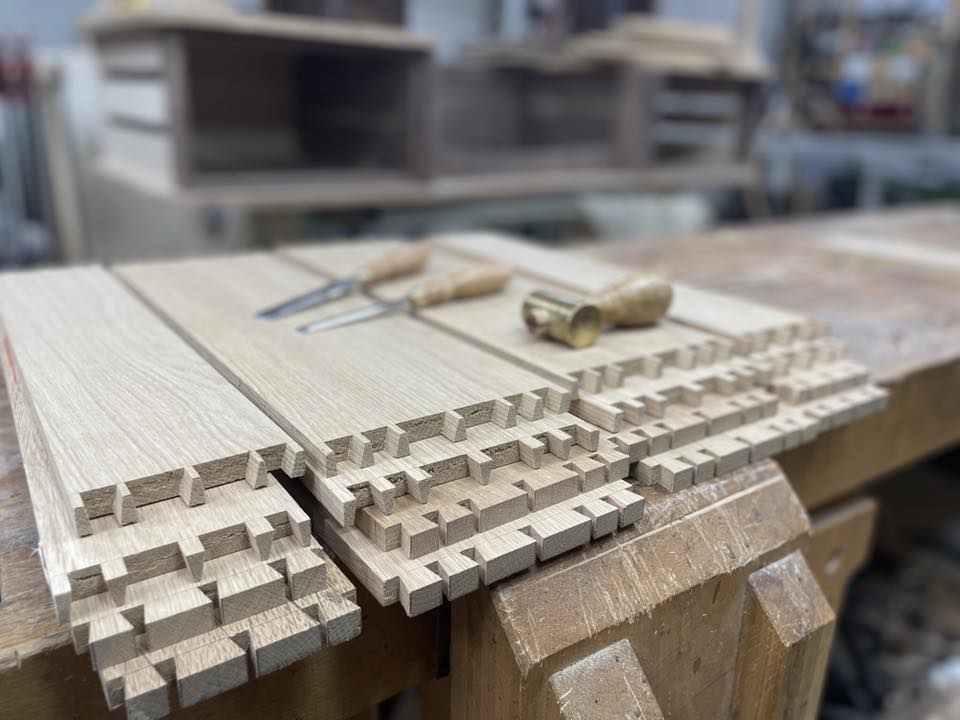
In my workshop, there are many areas that could easily be handled using modern tools and technology. Take cutting dovetail joints, for example – one of the fundamental joinery methods used in my furniture.
Once, a fellow woodworker visited my workshop and calculated that one of my furniture pieces required over 18 feet of dovetail joinery. As if that were not enough, those joints would remain invisible, hidden behind tambour doors. What a waste of time! He could not understand why I cut them by hand.
By design, I try not to expose joinery in my furniture, so yes – I could cut them with machines. It would reduce the entire process to two hours. However, because I have always cut every joint by hand, the entire process now takes me about eight hours instead of four days, as it does for my interns.
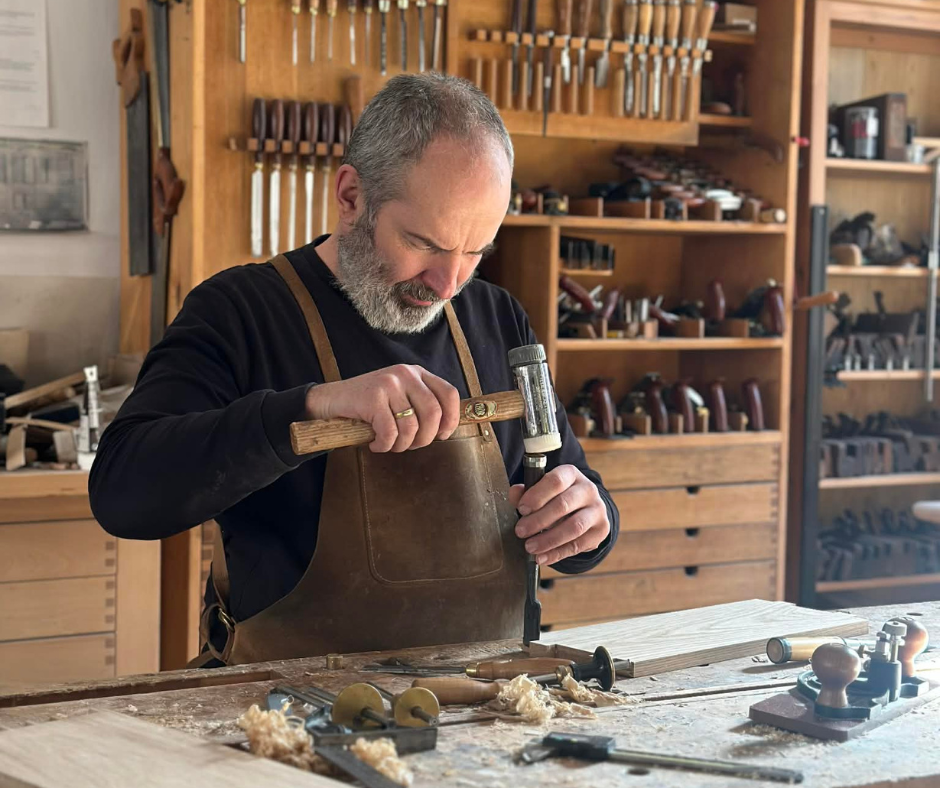
Yes, I could shorten the process by using machines, but that approach would lead me to lose something far more important than time: the fundamental woodworking skills that allow me, in many other situations, to create custom elements by hand without needing specialized machines or jigs. Ultimately, I would lose the ability to make the kind of furniture I create today.
Hand-cutting dovetails is my woodworking equivalent of practicing scales – training that keeps me in shape. Thanks to that, I possess the skills that allow me to create furniture at the highest level. Those skills give me freedom.
And here we return to the starting point. The narrative of “saving” traditional craftsmanship may seem intuitive, but in reality it leads us in the wrong direction because it assumes we are dealing with something belonging to the past that requires protection. As a result, craftsmanship becomes locked within aesthetics and sentimentality, functioning more as a symbol or a story than as a real working practice.
If we want to seriously discuss the place of traditional woodworking techniques today, we must approach them differently. We must honestly evaluate both their limitations and their genuine advantages, and only then consider where and how they make sense. Only then can they be consciously applied and truly coexist with technology, which today is not an alternative, but a natural part of our working environment.
Conscious woodworking as a direction for development
This is what I call conscious woodworking – understood as a way of making decisions in our work. In this approach, the choice of method does not arise from attachment to tools or from available technology, but from the goal, the quality, and the responsibility for the result we want to achieve.
Only from this perspective do traditional woodworking techniques stop being treated as an alternative to modern solutions and instead begin to function as one of many tools available to us – tools which, when used at the right moment, allow us to work with greater precision, freedom, and without limitations that often remain invisible until we try to overcome them.
This is not merely my own observation based on everyday work in the workshop. In the European report Crafting Health and Wellbeing, prepared by the European Crafts Alliance in cooperation with the research team from the University of Eastern Finland and presented in Florence, craftsmanship was presented as an important element of the contemporary socio-economic system, influencing quality of life, approaches to work, and the relationship between people and the things they create.
This publication also featured my workshop as an example of a practice based on consciously combining material, process, and personal skill.
This clearly demonstrates that craftsmanship is not a closed chapter of history or an area requiring preservation as a museum relic, but a living discipline that – if properly understood – has its place in the contemporary world and can continue to evolve within it.
So instead of asking how to save craftsmanship, perhaps we should begin with something much simpler – and at the same time much more difficult: trying to truly understand it.


