
On Thursday, April 30, 2026, the results of the European report “Crafting Health and Wellbeing” were presented in Florence during the European Crafts Alliance conference. The publication brings together research and real practices from across Europe, focusing on the relationship between craft, health, and wellbeing.
My work and Bensari Workshop were included in the report as a full case study, representing the only craftsman from Poland. The intention of this case study is to describe craft as a method of work: a way of making decisions, working with material, and building quality through process.
The report was developed by a research team from the University of Eastern Finland led by Dr. Sirpa Kokko, in collaboration with Dr. Niina Väänänen and Dr. Riikka Hirvonen. Their work is based on academic research, surveys, and interviews with craftspeople and educators across Europe, placing craft in a broader social and systemic context.
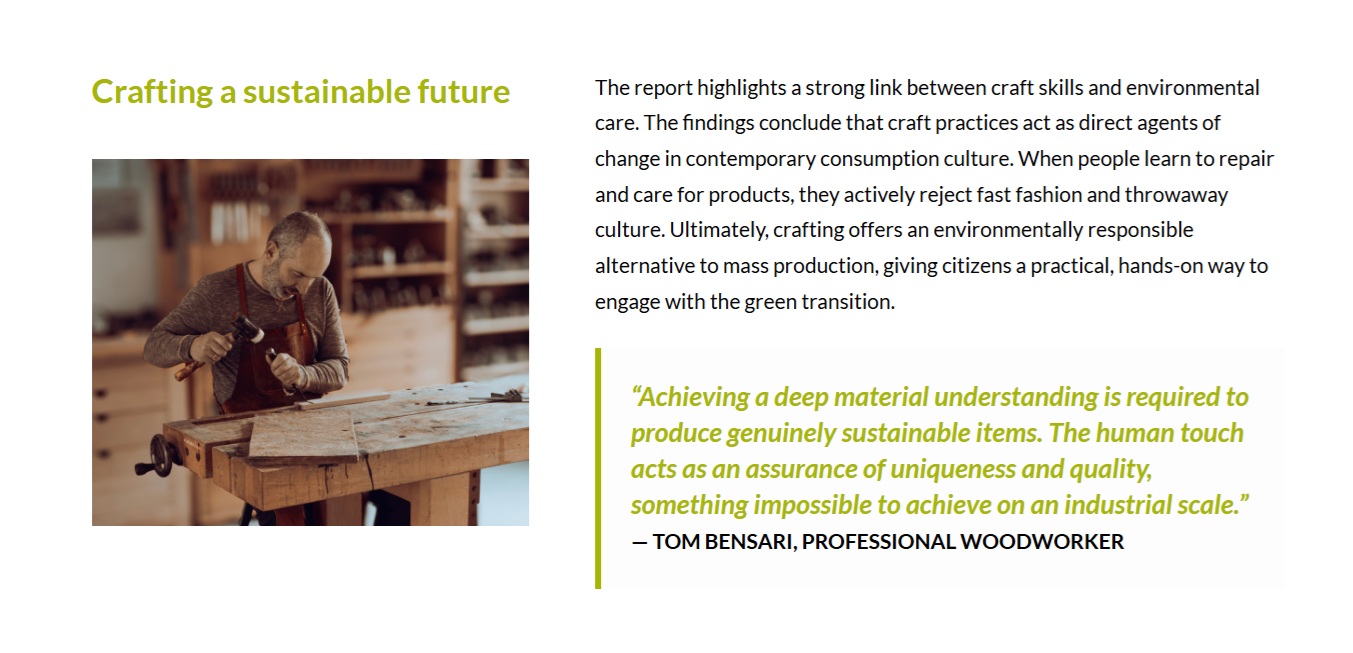
The publication also includes photographs from my workshop, documenting the actual making process. They show manual work, the relationship with material, and the sequence of decisions that shape the final object. This perspective matters, because craft is often reduced to a concept, while much less often it is presented as a working reality.
One of the central themes of the report is wellbeing. Working with one’s hands supports concentration, structures thinking, reduces tension, and strengthens a sense of agency. These effects are closely connected to the nature of the process, which requires attention, repetition, and responsibility.
The report also highlights something I recognize from my own experience. Craft introduces structure and rhythm into daily work. Over time, it becomes a framework for how work is approached and carried out.
A clear distinction is made between craft as a hobby and craft as a profession. In the professional context, it becomes a way of working that shapes identity and provides a sense of meaning. This aligns with how I approach my work, where craft is treated as a method rather than a category or aesthetic.
The report connects craft with environmental responsibility and contemporary production. Craft practices encourage responsibility for material, careful decision-making, and durability. Without understanding the material, it is difficult to speak about quality. Without quality, durability cannot be achieved.
Another important aspect is how knowledge is transmitted. Craft relies on hands-on experience, mistakes, and correction within the process. This cannot be replaced by theory or fully translated through digital means.
The report also points to a broader issue related to education and access to craft training. At the same time, the demand for quality and durability continues to grow. This imbalance is becoming increasingly visible.
These findings resonate with a wider discussion on wellbeing, which has also been present in the design field. The theme was central to the anniversary issue of Design Alive, where I published a column on the role of craft in contemporary practice. Both the publication and this report point in the same direction: craft as a working method that influences quality, focus, and decision-making.
Participating in this project has positioned Bensari Workshop within an international context and opened a broader discussion about the role of craft in contemporary Europe. It also confirms that a practice based on material, process, and consistent work on quality is understandable beyond a local setting.
The full report is available here:
https://europeancraftsalliance.org/crafting-health-and-wellbeing-a-european-crafts-alliance-sector-report/

