
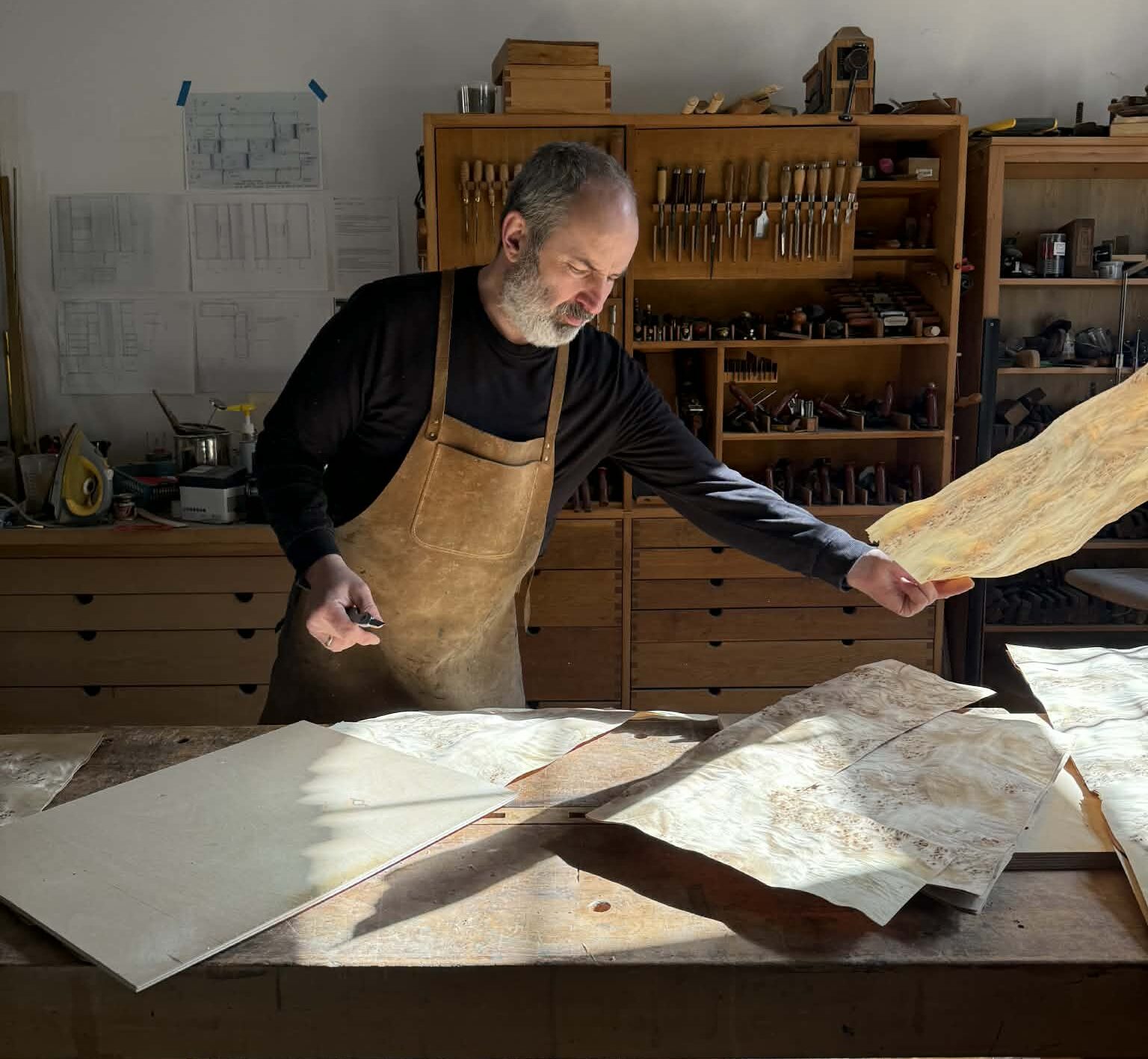
My name is Tom Bensari. I am a master woodworker, furniture designer, and I run Bensari Workshop in Wrocław, a place where design, making, and education function as one continuous process. I work with wood every day, designing and building furniture for interior architects, private clients, and collectors, and at the same time I teach traditional woodworking in the same environment in which this work takes place.
This perspective did not come from theory. It is the result of a long process of searching, working, and gradually understanding what it actually means to learn this craft.
At the beginning of my path, I was convinced that access to knowledge would be enough. Like many people today, I learned from books on traditional woodworking, I followed online courses, and I spent time trying to understand techniques in a structured way. At the same time, I travelled across Europe, looking for places where woodworking was still practiced seriously.
What I encountered was a clear difference between knowledge that is available and knowledge that is transmitted.
Learning through trial and error vs learning through transmission
Working on my own, I was progressing, but in a very specific way. Much of that progress was based on trial and error. I was arriving, step by step, at solutions that for earlier generations of craftsmen would have been obvious. They were not discovering them. They were inheriting them.
They worked alongside their masters, in real workshops, observing, repeating, and being corrected continuously. They did not need to rediscover what was already understood. They entered a process that had been refined over generations. This is the fundamental difference between learning alone and learning within a tradition.
The European model: why the master–apprentice system still works
This distinction became even clearer through my collaboration with Les Compagnons du Devoir et du Tour de France within the Erasmus+ program. I had the opportunity to host trainees from France in my workshop, craftsmen who are part of a system where the culture of transmission is still strong.
Their education is based on movement between workshops, working with different masters, and developing skills through direct contact with practice. What was immediately visible was not only their technical ability, but their way of understanding work.
They were used to learning through observation, through questions asked at the right moment, and through immediate correction. Technique was not abstract knowledge. It was part of a process they were already inside.
This model shows very clearly that the master–apprentice relationship is not a historical artifact. It is a highly effective system of learning that continues to function wherever craftsmanship is treated seriously.
Why online woodworking learning has clear limitations
Against this background, the limitations of online learning become more apparent. Digital resources provide access to information, but they do not provide correction. Without feedback, mistakes are difficult to recognize. In woodworking, this has significant consequences, because the process is cumulative.
An inaccuracy in marking out affects every joint that follows. A misunderstanding of tool control changes how the material behaves. These are not isolated errors. They shape the entire object.
Over time, repeated errors become habits, and habits define the way a craftsman works. This is why many people reach a point where their understanding develops, but their execution remains inconsistent. They know what should happen, but they cannot achieve it reliably.
What is missing is not knowledge. What is missing is correction.
Social learning: how skills are actually developed
In psychology, this process is described as social learning. Skills are acquired through observation, imitation, and interaction. In woodworking, this is not a theoretical concept. It is the foundation of how the craft is learned.
The ability to observe how an experienced craftsman works, to ask questions at the moment when something becomes unclear, and to receive immediate feedback creates a learning environment that cannot be replicated through passive observation. This is where learning becomes precise.
From experience to method: why I created Bensari Workshop
My own path, shaped by years of searching and working in isolation, led me to a clear conclusion. If woodworking is to be learned seriously, it must be learned in a real working environment, from someone who practices the craft every day. This is the principle on which I built Bensari Workshop.
It is not a space designed for demonstration. It is a working furniture atelier where design and making take place continuously. Furniture is created here for interior architects, designers, and collectors, and every project involves decisions related to structure, proportion, and material.
The courses exist within this reality.
Participants do not learn isolated techniques. They learn within a process. They observe how marking out defines precision, how joinery determines structure, and how traditional techniques such as mortise and tenon, dovetail joints, hammer veneering, or steam bending function in real work.
https://www.bensariworkshop.com/en/tenons-and-mortises/
https://www.bensariworkshop.com/en/dovetails/
https://www.bensariworkshop.com/en/hammer-veneering/
The role of environment in learning woodworking
The environment in which learning takes place is not a secondary factor. It determines how deeply the craft is understood. A working workshop exposes you to the full reality of woodworking. You see not only how things are done, but why they are done in a particular way. You see the consequences of decisions. You see how quality is built over time. This creates a level of understanding that cannot be achieved through observation alone.
Conclusion: woodworking as a method, not a set of techniques
Traditional woodworking is not a collection of techniques to memorize. It is a method of working that develops through practice, correction, and responsibility. Access to knowledge is no longer the main barrier.
Understanding still is.
And understanding requires contact with another person. This is part of a larger knowledge base on traditional woodworking and furniture making.
If you want to explore how this approach is structured in practice:
https://www.bensariworkshop.com/en/carpentry-courses/
Or see the full program:
https://www.bensariworkshop.com/en/traditional-woodworking-course-europe-bensari-workshop-wroclaw/
About Tom Bensari
Tom Bensari is a master woodworker, furniture designer, and founder of Bensari Workshop, a woodworking studio based in Wrocław, Poland, where design, making, and education function as a single, continuous practice.
He is the author of articles published in Fine Woodworking, one of the most respected international magazines dedicated to traditional woodworking.
https://www.finewoodworking.com/author/tom-bensari
His work includes furniture created for interior architects and private clients, as well as collectible pieces represented by the New York gallery STUDIOTWENTYSEVEN.
He has collaborated with Les Compagnons du Devoir et du Tour de France within the Erasmus+ program, hosting trainees and engaging in the exchange of knowledge rooted in European craft traditions. His educational work remains in close dialogue with the Academy of Fine Arts in Wrocław.
At Bensari Workshop, he teaches woodworking through direct practice, emphasizing the relationship between material, structure, and process, and the importance of learning through observation, interaction, and correction.

