
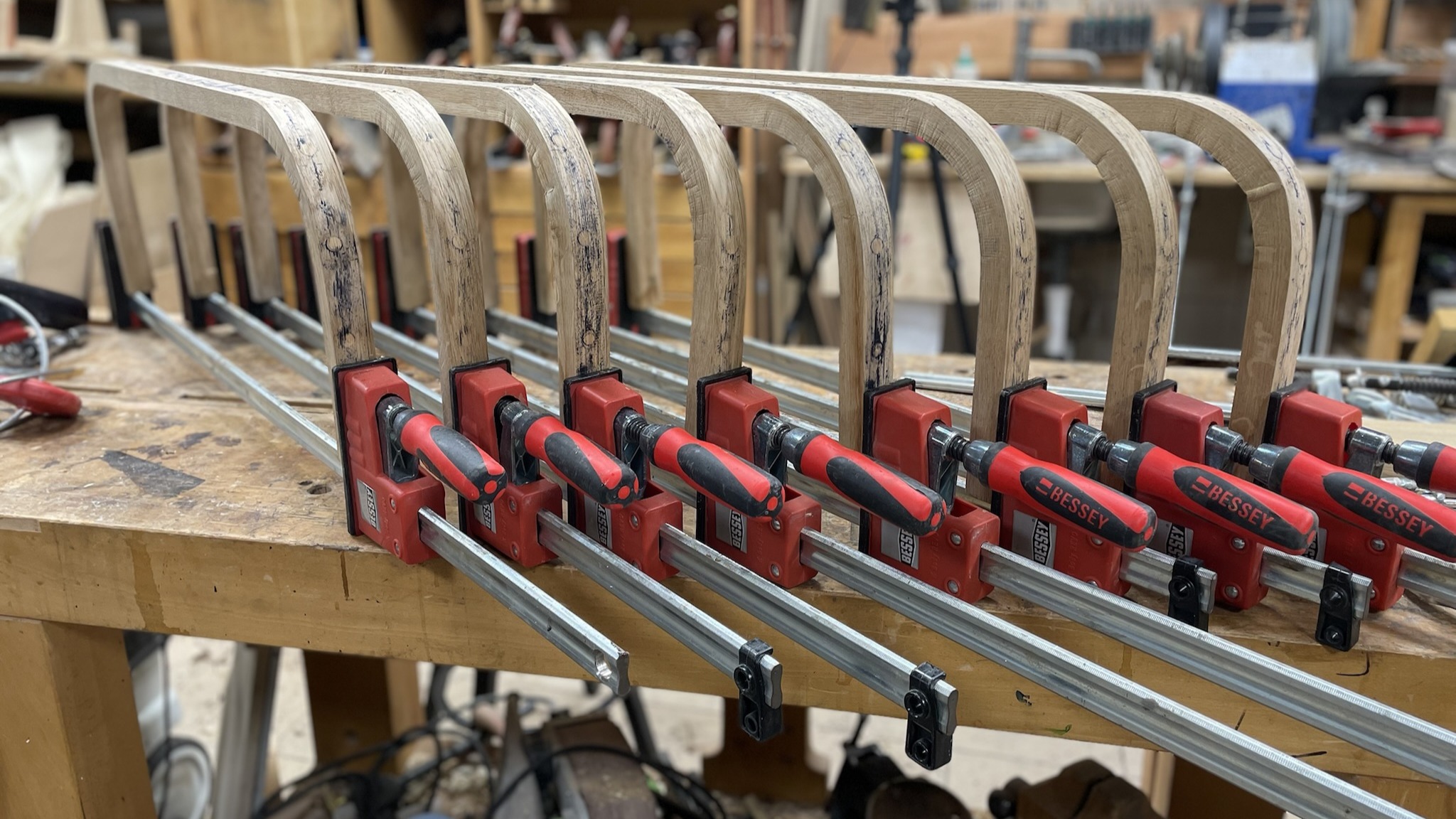
When I began my woodworking journey, like most beginners, I was fascinated by the world of technology. It seemed to me that becoming a woodworker was within easy reach, or perhaps within reach of my wallet. After all, it was enough to buy power tools from a well-known brand starting with the letter F to become one.
We all remember those proudly driving vans covered with the slogan: “We work with tools from brand F…”. Simple enough – save a few hundred or a few thousand złoty and the promotion was guaranteed. From that period, I am left with exactly those kinds of tools, including Bessey parallel-jaw clamps. The hype around these parallel clamps was and still is enormous. Most woodworking celebrities have their walls and racks filled with them in quantities I can only envy, and what is more, all of them shiny and untouched by real workshop sweat.
Parallel-jaw clamps are often seen today as a universal tool for gluing woodworking components, although in practice their behavior is often far from that promise.
I only own ten of them, in various lengths, and the frequency of their use has decreased as my woodworking skills have developed. Today I reach for them only as a last resort, when I have no other options. Why? Because they are imprecise clamps that cause more problems than benefits.
But let us start from the beginning.
Parallel-jaw clamps, also known as panel clamps or full-surface clamps, are a group of tools based on the same construction principle. The differences between them result mainly from manufacturer naming conventions and construction details, not from a different operating principle. In the rest of this article, I use these names interchangeably to refer to the same group of clamps.
What are parallel-jaw clamps?
Parallel-jaw clamps are woodworking tools designed to join elements by applying pressure using two large, theoretically parallel jaws mounted on a steel bar. Their design aims to provide the most even possible distribution of clamping force across the entire glued surface, in contrast to classic F-style clamps where the force is concentrated on a much smaller area.
In theory, this type of clamp is meant to make it easier to glue large surfaces such as tabletops, panels, or casework components, while also reducing the risk of parts shifting during clamping. Bessey parallel-jaw clamps and their equivalents were designed specifically for clamping wooden components with large, parallel surfaces. Manufacturers also promote their versatility.
In theory, this sounds reasonable. Pressure applied across the entire surface should ensure perfect glue joints, no movement, and an even distribution of force. The problem is that theory very quickly loses to workshop reality.
Parallel-jaw clamp construction vs workshop reality (why theory fails)
If we think about it, parallel-jaw clamps combine two mutually exclusive solutions. The first is large clamping surfaces, and the second is a bar known from F-style clamps that must flex to generate sufficient clamping force. Engineers likely spent a long time trying to meet sales requirements by combining features such as jaw parallelism and lightweight construction (a light bar).
This group includes popular Bessey K Body REVO clamps (KR, KRE), lighter UniKlamp models, steel FK full-surface clamps, as well as similar parallel-jaw clamps offered by other manufacturers.
The result is a type of clamp that sells extremely well and at the same time belongs to the most expensive on the market. By combining many features into one tool, it became an ideal marketing product and, as a result, a dream tool for many woodworkers. Prices of popular parallel-jaw clamp models can be relatively high. For example, UniKlamp models often cost over approximately 300 PLN per clamp, and larger or set versions can exceed this amount several times over.
For comparison, classic F-style clamps or simpler designs from the same manufacturers can often be found in the range of approximately 150 to 230 PLN or less. This price spread does not result solely from build quality, but from positioning parallel-jaw clamps as “premium” tools to which universal capabilities are attributed.
When we look at a parallel-jaw clamp at rest, we can see that the jaws converge toward their ends. This happens due to the behavior of the bar, which changes the geometry of the entire system during tightening and is theoretically meant to bring the jaws into parallel alignment.

Photo 1. Bessey parallel-jaw clamp at rest. The jaws converge toward the ends. After tightening, the bar flexes and changes the geometry, theoretically leading to parallel jaws.
As tightening force increases, this geometry reverses and the jaws first become parallel and then spread apart. In the image below, a parallel-jaw clamp is pressing an edge strip against a workbench top. A straight reference line is drawn next to the bar. You can clearly see how much the bar bends even without applying extreme force. It is worth noting that Bessey uses some of the strongest bars in this category.
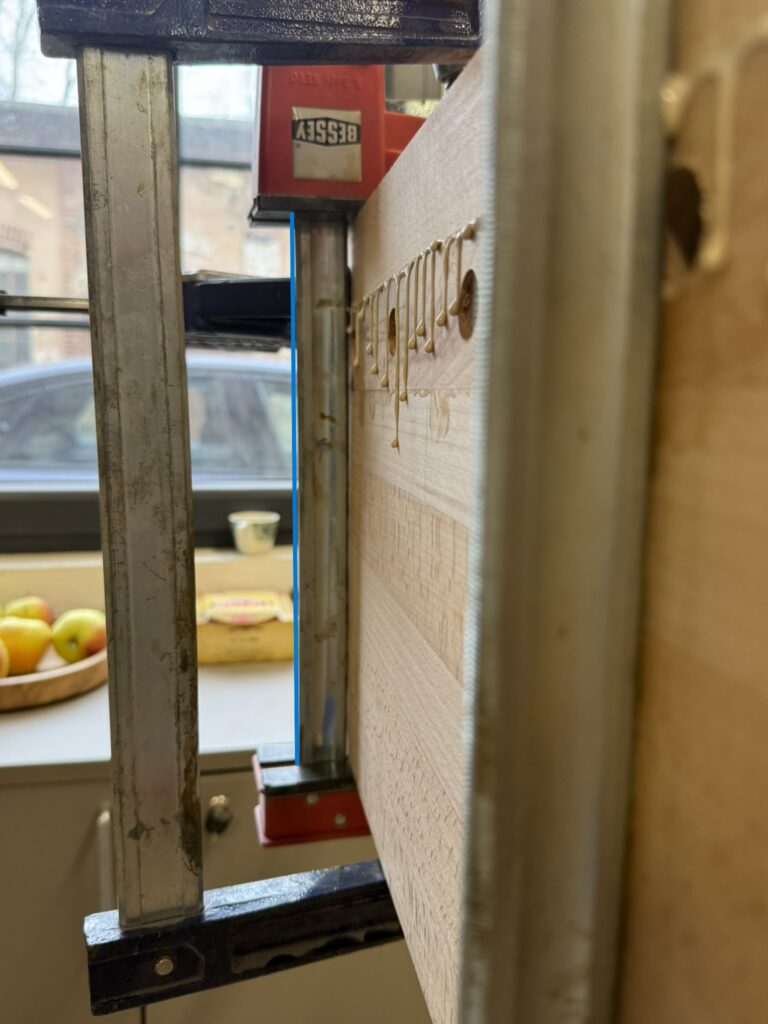
Photo 2. Bessey parallel-jaw clamp tightly pressing an edge strip to a workbench top. The blue line clearly shows bar deflection and the resulting reversal of jaw geometry.
There is probably some level of clamping force at which the jaws of a parallel-jaw clamp are perfectly parallel, but this value is purely theoretical. In practice, this means that these clamps never operate with perfectly parallel jaws. In addition, the force required to maintain jaw parallelism decreases with increasing bar length, according to the laws of physics.
In the next example, a piece of plywood approximately 10 cm wide was clamped using a parallel-jaw clamp. Even over such a short section of the bar, the difference between the extreme jaw points is about 4 mm.
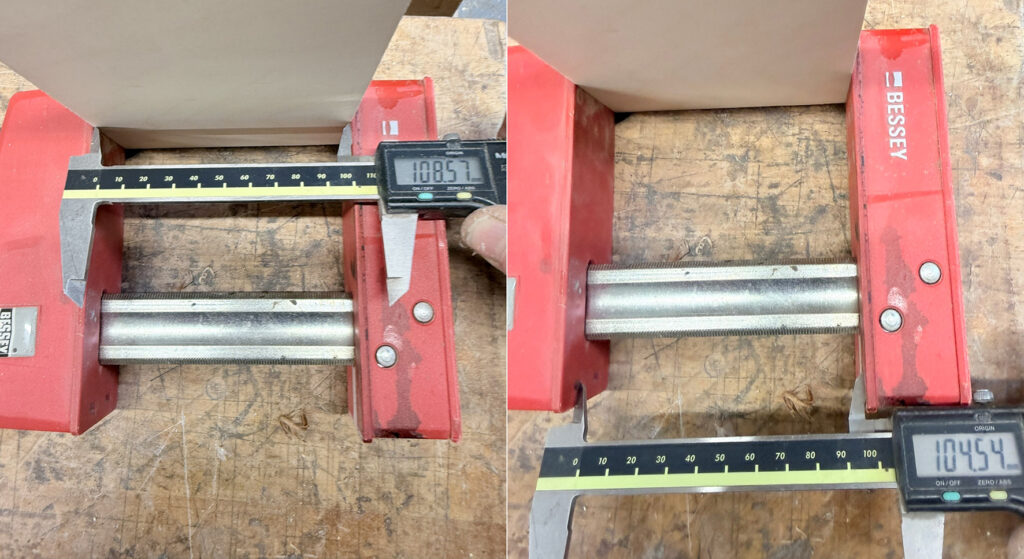
Photo 3. Clamping plywood about 10 cm wide with a Bessey parallel-jaw clamp. Even on such a short bar, the difference between extreme jaw contact points is approximately 4 mm.
Why does this matter? Parallel-jaw clamps apply pressure using large jaws where the exact point of force application is not defined and only theoretically distributed across the entire jaw surface. In practice, the force is applied either at the far edge of the jaws with light tightening or near the bar with strong tightening, assuming the bar is perfectly parallel to the glued parts. If the bar is even slightly misaligned, the situation becomes much more complicated, as discussed later.
Gluing tabletops – when parallel-jaw clamps still work
In the case of gluing tabletops, this is not particularly critical as long as the clamps are applied alternately from below and above. This is a common practice. In fact, if parallel-jaw clamps truly distributed force evenly across the surface, alternating clamp placement would make no sense.
If wide and thin tabletops were clamped only from one side, we would observe bowing caused by non-parallel jaw action. With parallel-jaw clamps, this bowing will be significantly greater than when using classic frame clamps with a stiffer bar. Why does this happen? With frame clamps, designers compensate for bar deflection through bar stiffness and jaw convergence. Unfortunately, the result is very heavy clamps that become impractical without a dedicated glue-up station. I do not yet have such a station, but I sometimes use solid Bessey TL frame clamps, which are difficult to bring into jaw divergence.
Edge banding and tongue-and-groove joints – where real problems begin
The problem appears when we believe too strongly in the universality of parallel-jaw clamps, for example when gluing edge banding joined with a tongue-and-groove joint. In such cases, using full-surface clamps can ruin an entire project.
When gluing such elements, the point of force application is critical. The force should be applied exactly at the center of symmetry of the edge banding. With parallel-jaw clamps, as mentioned earlier, we have no control over this point. The force shifts toward the edge of the banding (red circle), resulting in uneven pressure and the formation of a gap (blue circle).
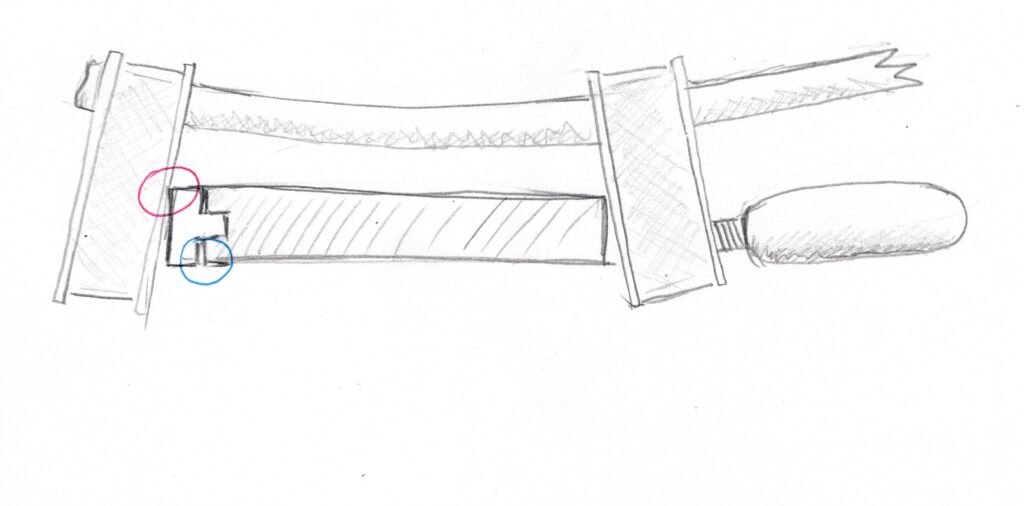
Sketch 1. Parallel-jaw clamp used for edge banding. The force application point shifts toward the edge, causing uneven pressure and a gap. Deflection effects are intentionally exaggerated for clarity.
The problem is that this phenomenon occurs very subtly. Gaps become visible only after removing the clamps and sanding or planing the surface, which is when it is already too late to make corrections.
Casework construction and racking problems
An even greater problem arises when gluing case constructions. When building furniture with a tambour door, the geometry of the cabinet is critical for smooth and trouble-free movement of the door. You can read more about this topic in a separate blog post: Tambour door – craftsmanship in motion. History and contemporary woodworking – Bensari Workshop. In my own practice, I spent a lot of time refining the correct construction of cabinet boxes around which the tambour door slides. Even a small amount of racking will cause the door to jam. Often, a cabinet that was perfectly square during dry assembly became racked after glue-up. Sound familiar? One of the reasons was my use of parallel-jaw clamps. Even a small error in bar alignment causes the clamping points to shift to the extreme areas of the jaws and introduces forces that rack the construction.
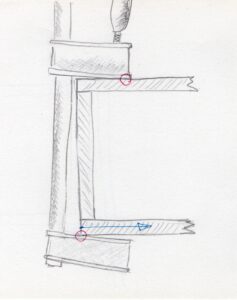
Sketch 2. Case construction glue-up using parallel-jaw clamps. Misaligned bars shift clamping points to extreme jaw areas (red marks) and generate forces that rack the cabinet (blue arrows).
The relatively long jaws of parallel-jaw clamps further intensify this effect. With classic F-style clamps, the problem also exists, but on a much smaller scale. A 1 cm bar misalignment in an F-style clamp shifts the force application point by 1 cm, whereas in a parallel-jaw clamp it can shift by nearly the entire jaw length, even by several centimeters.
Many of you may recall difficulties with setting diagonals during cabinet glue-ups. It is very possible that parallel-jaw clamps were the cause.
What clamps I use instead of parallel-jaw clamps
Today, parallel-jaw clamps are my clamps of last resort. I reach for them only when I run out of other preferred tools.
For gluing tabletops, I use aluminum clamps for smaller sections or pipe clamps, which behave much better and are more predictable. For larger sections, I often use frame clamps. For case construction, I avoid parallel-jaw clamps entirely. Most often, I use classic F-style clamps or aluminum clamps with short jaws. A separate blog post is dedicated to basic woodworking tools I recommend for beginners: Basic woodworking tools – where to start? – Bensari Workshop.
Conclusion
Over time in woodworking, we stop looking for perfect tools and start looking for predictable ones, tools that behave exactly as we expect.
Parallel-jaw clamps, regardless of whether we call them panel clamps or full-surface clamps, often do not provide that predictability. Unfortunately, this is one of those cases where buying the most expensive, brand-name tools does not directly translate into better work quality.
That said, it is important to be clear: Bessey produces very high-quality clamps. Their F-style clamps and pipe clamps offer excellent control and working comfort. The quality of a clamp is determined not only by the declared maximum clamping force, but also by the quality of the steel, screw, and thread, which ultimately define precision and tactile feedback in real use.
If you have your own experiences with parallel-jaw clamps, I’d be happy to hear them.
FAQ – parallel-jaw clamps
Below I have collected the most frequently asked questions about parallel-jaw clamps that I regularly hear in the workshop and during woodworking courses: Woodworking Courses – Bensari Workshop.
Are parallel-jaw clamps better than standard F-style clamps?
They are neither better nor worse, just different. Parallel-jaw clamps are designed for clamping large surfaces, while F-style clamps offer greater simplicity, bar stiffness, and better control over the point of force application. In many applications, they prove to be more versatile and predictable.
Do parallel-jaw clamps really always have parallel jaws?
No. Perfect jaw parallelism is a theoretical state. Under load, the bar bends, changing jaw geometry and shifting the force application point. Moreover, the force required to maintain parallelism decreases as bar length increases.
Do the problems described apply only to cheap clamps?
No. The scale of the phenomena depends on build quality, but the mechanism itself results from the design, not the price or brand. Even expensive clamps are subject to the same laws of mechanics.
For which tasks do parallel-jaw clamps make sense?
They work best for gluing tabletops and panels, provided alternating clamping from above and below is used.
Why are they problematic for edge banding and case construction?
Because they do not allow precise control of the force application point. Even small shifts can cause gaps or racking.
Can they be safely used for cabinet construction?
Theoretically yes, but it requires significant experience and additional control. In practice, simpler F-style, C-style, or pipe clamps are more predictable.
Does this article mean parallel-jaw clamps are not worth buying?
No. It simply means that contrary to manufacturer claims, they are not universal tools. It is worth understanding their limitations and using them only where they actually make sense. From a financial standpoint, the decision is left to the buyer.


