

Traditional woodworking as a contemporary practice
The year 2025 was, for me and for Bensari Workshop, a period of intensive yet deeply satisfying work. This year clearly demonstrated that traditional woodworking is not a reconstruction of the past – it functions as a fully valid, practical working method, grounded in proven structural solutions and a conscious selection of techniques. Bensari Workshop is a woodworking studio based in Wrocław, where I design and build furniture on a daily basis, while also teaching woodworking techniques used in real workshop practice. It is a small studio, yet internationally recognised and respected for its uncompromising approach to quality and design. This is a place of real practice – without shortcuts, simplifications, or work detached from actual woodworking processes.Collectible furniture
My work operates primarily within the international collectible design market. I am represented by the New York gallery STUDIOTWENTYSEVEN, and the majority of the furniture I produce is commissioned by international clients. As a result, my projects find their place in private collections and exceptional architectural spaces outside Poland. One such location is the Watergate Complex in Washington, DC – an iconic modernist landmark where our audio cabinet from the Chameleon collection was installed.
Scale of work and quality of execution
In 2025, 6 original collectible furniture pieces and 1 custom piece commissioned by a designer were created in our workshop. Is that a lot? No. And I believe that this is precisely the point of my work. Each of these objects was designed and made entirely in this workshop – from the first sketch to the final detail – using classical woodworking techniques: mortise and tenon joints, dovetails, frame and panel construction, traditional veneering, and wood bending. In the workshop, we do not use prefabricated components or compromises – every element is made in-house, under full control of the process, and the execution of a single piece takes several months. This scale of production is a source of pride for me. I consciously do not work for quantity. I focus on quality, precision, and the internal coherence of each object. I create furniture aligned with the idea of quiet luxury – pieces that do not shout through form or colour, but stand their ground through exceptional design and craftsmanship. Despite a zero marketing budget, these objects find their way into the hands of renowned interior designers and discerning collectors. These are pieces worth waiting for. Clients commit to this process knowing that, in return, they will receive a unique collectible object, handmade, uncompromising, and executed with full respect for the material. Such work requires time – and it is precisely this time that gives these pieces a value that cannot be replicated. Alongside furniture production, we also designed and built our own tools, workbenches, and workshop furniture, intended for long-term, intensive use. I consider this a professional standard – if something is meant to serve craftsmanship, it must be made according to the rules of the craft and designed for real, everyday use.Woodworking courses and craft education
Woodworking courses at Bensari Workshop
Driven by the idea of building the best woodworking school in this part of Europe, in 2025 I organised nearly 40 woodworking courses – ranging from hand tool work to structural techniques used in furniture making and conservation. This is an intensive programme based on the same techniques I use daily in my design and making practice. I must admit that a hidden goal of this school is to educate my successors, especially given that vocational education in our country has long since moved away from this form of craftsmanship. Importantly, nearly 80% of course participants come from outside Wrocław and the region, and increasingly also from outside Poland. Bensari Workshop attracts participants from across Europe, who regard the studio as a significant point on the map of contemporary craft education.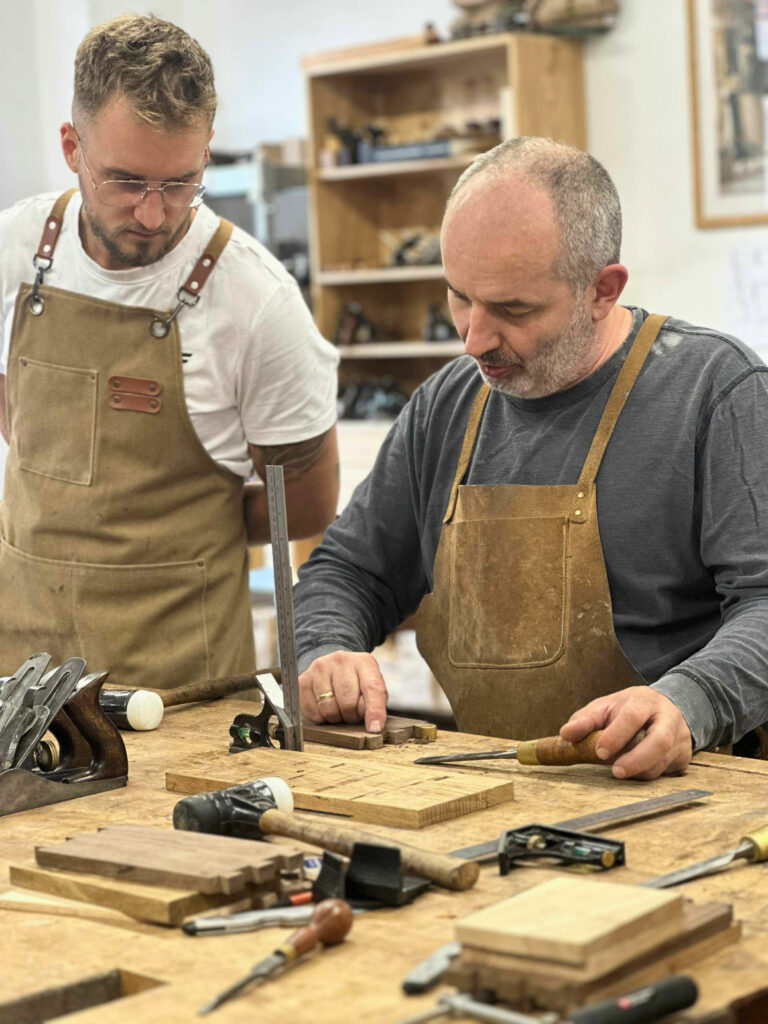
International education – Erasmus+ and students from France
In 2025, I hosted students from France for three weeks at Bensari Workshop – members of Les Compagnons du Devoir, one of the most respected craft education institutions in Europe. Their presence was part of an international educational exchange and took a fully practical form. The students worked within the normal workshop rhythm, participating in the entire woodworking process – from structural analysis and material preparation, through joinery, to finishing work. We worked with the same techniques I use daily in furniture making – without simplifications or staged demonstrations.
Internships and learning the trade in a real environment
An important element of the past year was also the internship of Rafał Wojciechowski, which clearly illustrates the value of learning a trade in a real craft environment. An internship at the workshop is not about observation or auxiliary work, but about gradually entering the full woodworking process – from material and structural decisions to responsibility for detail and execution quality. As a structural engineer, Rafał confronted his previous technical experience with the practice of traditional woodworking, learning to think about furniture not only as a functional object, but as a structure that requires time, precision, and consistency. This learning model – based on daily work alongside a master, on creating real objects, through courses and special projects – allows craftsmanship to be understood as a profession rather than a set of techniques.
Special projects and craftsmanship in the service of culture
The year 2025 also brought projects extending beyond classic furniture making. We co-created wooden components for the reconstruction of a late 16th century astrolabe – an astronomical measuring instrument used in navigation – designed by Zacharias Bornmann, a historical resident of Wrocław. This work required high precision, strict geometric dependencies, and material control at every stage. Another valuable experience was working on the conservation of organs at the National Forum of Music and the restoration of historic organs in several Lower Silesian churches, carried out in cooperation with Atelier Organmistrza Andrzeja Lecha Kriese. In these projects, traditional woodworking techniques were a real condition for durability and fidelity to the original construction.Media presence and publications
The year 2025 brought significant media exposure for both myself and Bensari Workshop, resulting from ongoing design, making, and educational work. Media became a space in which specific projects and ideas could resonate within a broader context of architecture, design, and material culture. The most important media event of the year was the international coverage of the Watergate Complex apartment project in Washington, DC, designed by Nicholas Potts, which featured an audio cabinet made in our workshop in collaboration with Wrocław-based artist Roland Grabkowski. The project was featured by: Architectural Digest Vogue Design Milk These publications highlighted our object and demonstrated that a handcrafted piece made in a small woodworking studio can function within iconic modernist architecture and the highest tier of international design. An important complement to this exposure was publication in Polish design media, where the same Washington project was presented in a local context. In Design Alive Home, the article “DA HOME – interiors you can fully immerse yourself in” showcased the apartment interior along with our work as part of a cohesive, consciously designed space. Another important moment for our workshop was the publication of our Jazz shelving unit from the Manhattan collection in the luxury magazine Robb Report, where it appeared among objects combining exceptional form, craftsmanship, and material nobility. The piece was featured in the US, German, Arabic, and Italian editions. In the article “On wood that becomes art” published in Elle Decoration, I was mentioned as one of the creators for whom wood is not merely a material, but a carrier of emotion, history, and craft mastery. This distinction confirms the coherence of my chosen path – from methodical study of woodworking, through creating collectible furniture at the highest level of craftsmanship, to developing Bensari Workshop as a place for passing this knowledge on. A significant moment of 2025 was also my conversation in the MAGAZIF podcast #13. It offered an opportunity to reflect on my path – from business, through choosing craftsmanship, to my current approach to design and working with wood. The discussion touched on material relationships, the importance of detail, attentiveness in the creative process, and the boundary between craft and art.
Award
In April 2025, I received a distinction in the 30 Creatives of Wrocław 2025 awards, in the Culture / Art / Design category. I treat this as confirmation of the path I have chosen – devotion to craftsmanship and the transmission of knowledge to future generations.Acknowledgements
Finally, I would like to thank everyone who was part of Bensari Workshop in 2025. I thank all woodworking course participants for their trust, commitment, and many expressions of appreciation. It is particularly meaningful to me that many people return to the workshop for further courses, deepening their knowledge and skills step by step. This is the best confirmation that the way I teach traditional woodworking – based on practice, consistency, and real workshop processes – makes sense. Thank you also for the conversations, questions, and exchanges of experience that are an integral part of every course. Tom BensariBensari Workshop


