
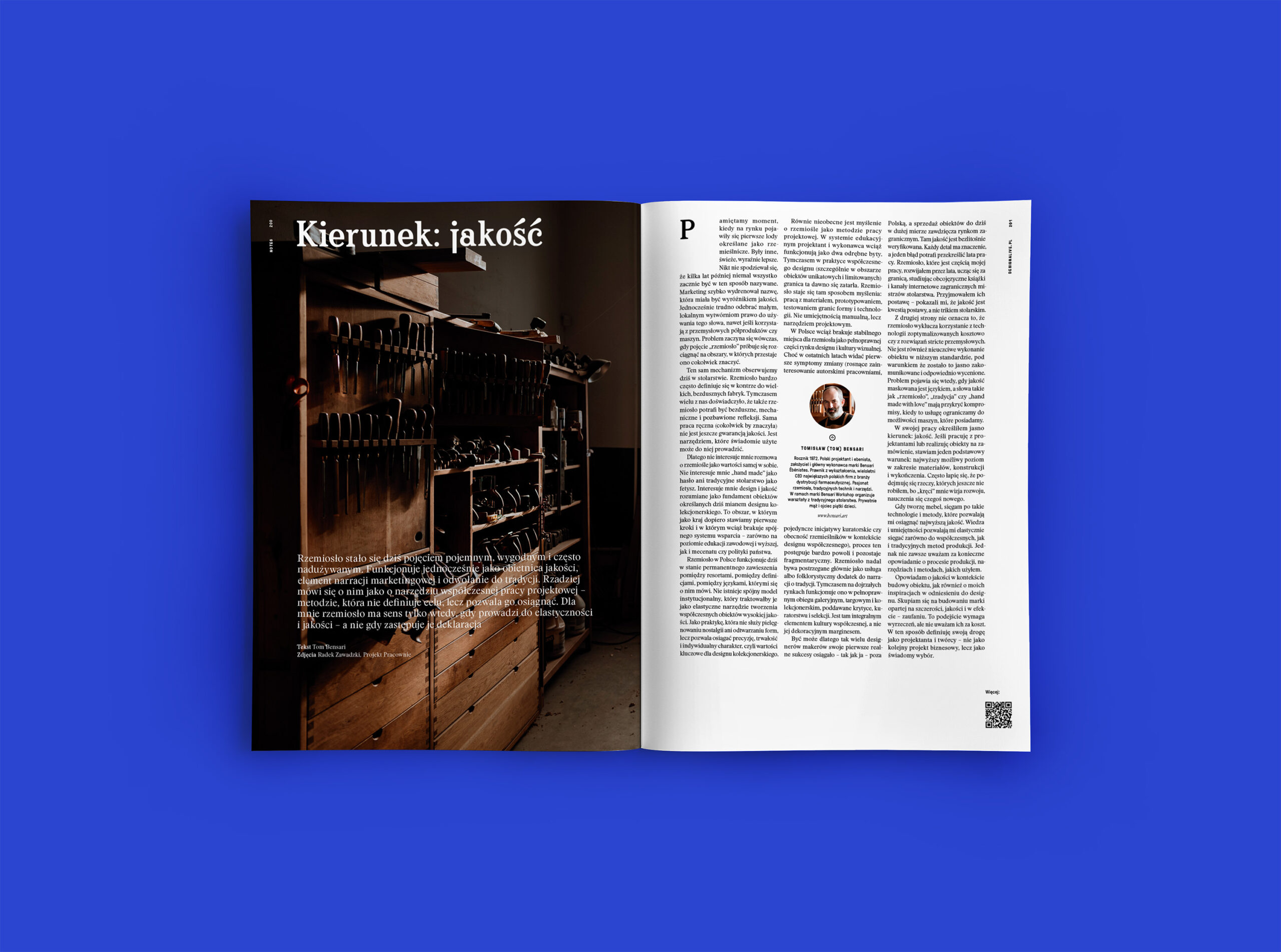
In the anniversary, 55th issue of Design Alive, whose main theme is well-being, my column “Direction: Quality” has been published. The text inaugurates a new section developed in collaboration with the editorial team, dedicated to the contemporary understanding of craftsmanship and its role in design.
In the same issue, the editorial team also highlights selected Polish craftspeople, among whom I have been included. I treat this as part of a broader conversation about what craftsmanship is today and what role it plays in design practice.
In the column, I address the changing meaning of craftsmanship. Increasingly, it functions as an element of communication, and less often as a real method of work. In my practice, craftsmanship is neither a goal nor an ideology. It is a tool that allows for conscious work with material, informed design decisions, and the achievement of quality within the process.
Craftsmanship does not define the final outcome. It defines the path that leads to it.
The theme of well-being gives this issue an additional context. Manual work is not an addition or an aesthetic choice, but a real experience that organizes attention, teaches patience, and builds a sense of agency. This directly influences the quality of work and the way the resulting objects are perceived.
In this perspective, craftsmanship is not a return to the past. It is a tool that allows for a more conscious way of functioning in the contemporary world.
This perspective is directly present in the work of Bensari Workshop – a woodworking studio and school of craftsmanship, where I create furniture and run woodworking courses, treating craftsmanship as a daily practice rather than a declaration.


