
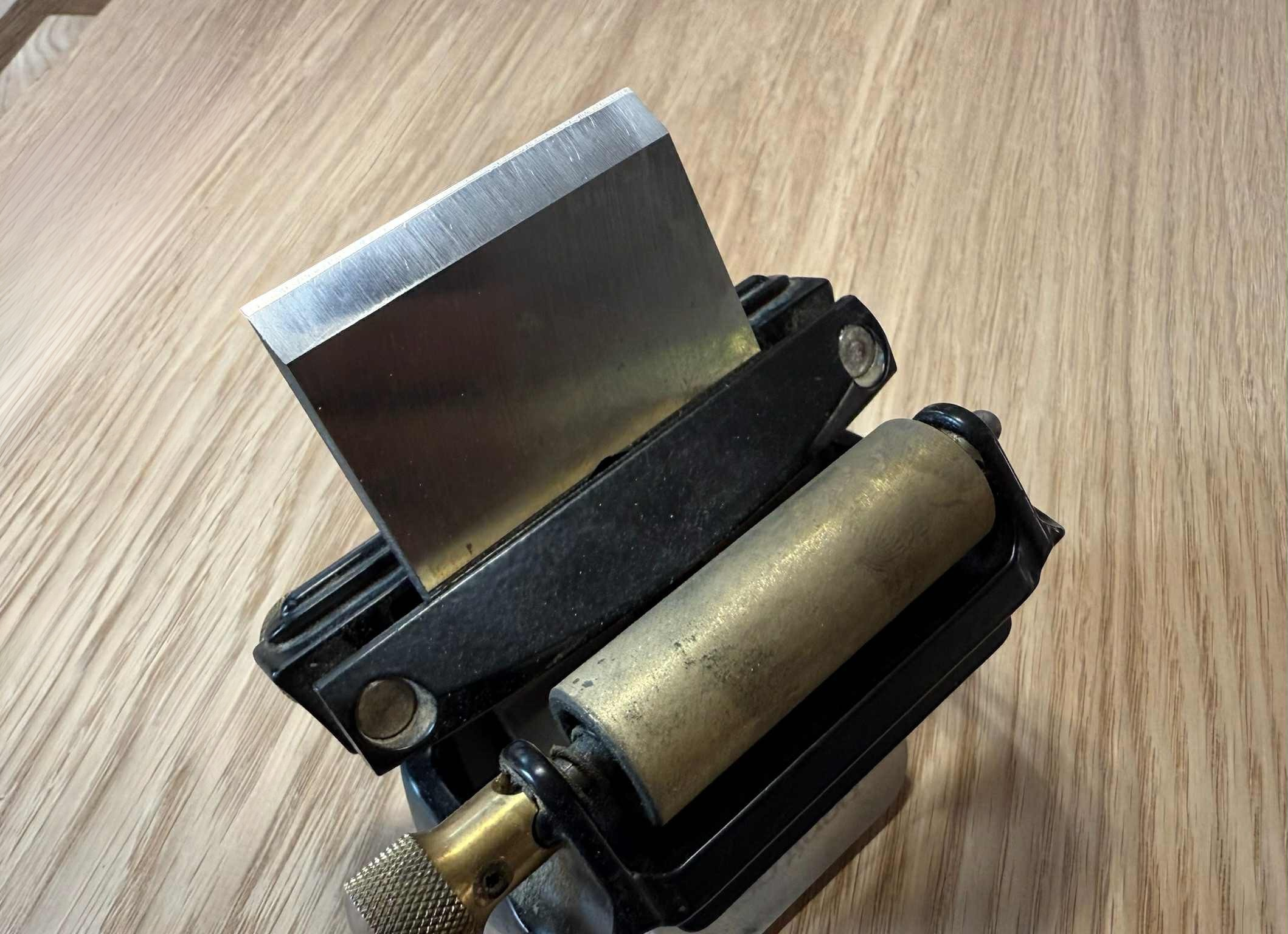
Today I’ll address the topic of the micro-bevel – a subject that heats up discussions in many social media groups. During woodworking workshops, I get plenty of questions about the validity of the micro-bevel. Often, participants speak very decisively about it, usually considering it a sign of the utmost care for sharpness and durability of the edge. But how do I see it? Let’s start from the beginning.
What is a micro-bevel?
A micro-bevel is an additional ground bevel at the very tip of the cutting edge, usually made at a steeper angle than the primary bevel (typically 1 to 2 degrees greater). It is created in the sharpening process.
Sharpening woodworking tools – guide or hand?
On a daily basis, I sharpen tools without the help of honing guides. Why?
– it’s faster – before most of you find and set up your guide, I already have a ready edge,
– it’s more precise – a trained eye and experienced hand are enough to achieve an excellent sharpening effect.
What is a honing guide?
A honing guide is a device that allows you to keep the tool at a constant angle during sharpening. It is a modern invention that appeared with the need to achieve repeatable results and an apparent – in my opinion – precision.
Also read: Basic woodworking tools – where to start?
Myth 1: The micro-bevel ensures greater edge durability
When a student asks me about the micro-bevel, I immediately ask him: why do you need a micro-bevel? Most often I hear about blade durability and sharpening speed. To a primary bevel sharpened at 30 degrees, a 2-degree micro-bevel is added precisely to increase sharpness and durability of the edge. Then I ask another question: why not sharpen directly at 32 degrees? In fact, that question ends the discussion about the micro-bevel increasing blade durability.
Myth 2: The micro-bevel speeds up sharpening
Indeed – at first, the micro-bevel may seem faster. But after a few cycles you still have to restore the full bevel, which requires much more work. The result? Short-term gain, long-term cost.
The micro-bevel is created quickly and easily, and it is impossible to precisely catch the moment when it is sufficient for the cutting edge to be properly ground. If we look at Figure 1, we’ll notice that establishing a micro-bevel, i.e. grinding the material marked in light green, later forces us to grind down all the material to the green line if we decide to restore the full bevel. If the micro-bevel size marked as M is 0.1 mm, then to restore the bevel we need to grind away 96 times more material than what was removed when establishing it, on a blade 4.8 mm thick.

Repeatedly grinding the micro-bevel (light red color) later forces us to grind all the material down to the red line.
Myth 3: The micro-bevel provides greater control over sharpening
The micro-bevel largely emerged as a response to the imperfections of honing guides. Small shifts when setting the blade cause different sharpening results. The micro-bevel “masks” the problem but does not solve it. No matter which honing guides I used, and I own several, each time the blade positioned itself differently in the guide (see Figure 2.)

If we were very lucky, our blade positioned itself perfectly relative to the sharpening stone – case A. This didn’t happen to me very often. Why? Probably for many reasons: different temperature, dust, inaccuracies of the tools. In the end it doesn’t matter – most often cases B or C occurred. And we’re not talking about large shifts. The drawings are illustrative. A shift of just a few microns is enough for the effect to show. If we were lucky, case B occurred. Sharpening is then fast, but on the bevel you can see a grind line, which at the beginning of my woodworking journey annoyed me a lot. Most often, unnecessarily, I tried to grind this bevel line away completely, which, just like in case C, took a lot of time. In case C the blade positioning unfortunately forces us to grind away all the material under the red dashed line in order to sharpen the blade at all. After some time I simply started correcting the blade’s position in the guide with a small hammer.
My experiences with the micro-bevel
For me, the micro-bevel is more of a marketing concept than a real necessity in woodworking practice:
– it gives quick results, but not necessarily the best,
– it may be used carefully as a finishing touch by experienced woodworkers,
– in practice, most people who work extensively with hand tools eventually move on to freehand sharpening.
In my view, the micro-bevel concept aims to bypass the problem of a poorly set blade in the guide and helps many less experienced users sharpen successfully. At least the first time. I know several excellent woodworkers who use the micro-bevel, but they certainly do it very carefully, and it serves only as a finishing touch to the edge. They apply it with great care not to overdo it, because they know well what such excess leads to.
How to approach sharpening?
– treat the honing guide as a transitional stage in learning,
– limit the micro-bevel to 2–3 strokes if you use it at all,
– practice freehand sharpening – it’s faster and more effective,
– focus on repeatability of results, not one-time success.
Summary – the micro-bevel and conscious woodworking
The micro-bevel is not a magic solution. It may help in exceptional cases, but in the long run it will not replace a conscious approach to sharpening woodworking tools. It’s worth remembering that it is repeatable results that prove mastery of the sharpening craft.
This article is meant to encourage you to reflect rather than define one “correct” approach to the topic. In the end, what matters is the outcome, and if it is repeatable and fast, it means your approach is correct and will be rewarded with satisfying work and results. At this point, I would strongly emphasize the word “repeatable.” A one-time success is not proof of anything.
👉 If you want to learn more and test it in practice, I invite you to woodworking courses at Bensari Workshop.


